Employee Conflict Resolution Training: The Ultimate Guide for Modern Workplaces
2 Dec 2025 · 9 min read
Conflict in the workplace is inevitable. Wherever you have a group of diverse individuals, each with unique backgrounds, distinct communication styles, and competing priorities, friction is bound to occur. While some level of debate can drive innovation, unresolved conflict is a silent productivity killer. It festers, lowers morale, increases turnover, and can even lead to legal complications.
This is where employee conflict resolution training becomes not just a "nice-to-have" professional development perk, but a critical strategic asset.
In this comprehensive guide, we will explore the nuances of conflict resolution, dissect effective strategies, and show you how to build a training program that truly transforms your company culture. We will also look at how modern technology, such as AI-driven simulation from platforms like Real Talk Studio, is revolutionising how we learn these soft skills.
Table of Contents
- The True Cost of Workplace Conflict
- Understanding the Anatomy of Conflict
- Core Pillars of Conflict Resolution Training for Employees
- 5 Proven Employee Conflict Resolution Strategies
- The Role of Emotional Intelligence (EQ)
- Simulation and Roleplay: The Missing Link in Training
- Designing Your Training Program: A Step-by-Step Guide
- Measuring the ROI of Conflict Resolution Training
- Conclusion: Building a Culture of "Real Talk"
The True Cost of Workplace Conflict
Before diving into solutions, it is essential to understand the magnitude of the problem. A study by CPP, Inc. (publishers of the Myers-Briggs assessment) found that U.S. employees spend roughly 2.8 hours per week dealing with conflict. That equates to billions of dollars in paid hours used purely for navigating disagreements rather than productive work.
But the financial cost is just the tip of the iceberg. The hidden costs include:
- Presenteeism: Employees are physically present but mentally checked out due to stress or anxiety about a coworker.
- Talent Drain: "People don't leave jobs; they leave toxic cultures." Unresolved conflict is a primary driver of high turnover rates.
- Siloed Teams: When departments feud, information stops flowing. Marketing stops talking to Sales, and the entire business suffers.
- Leadership Fatigue: Managers often spend up to 40% of their time acting as unauthorised mediators, taking time away from strategic planning.
Investing in conflict resolution training for employees is the only sustainable way to mitigate these risks. It shifts the responsibility from the manager to the individual, empowering every staff member to handle disputes autonomously and professionally.
Understanding the Anatomy of Conflict
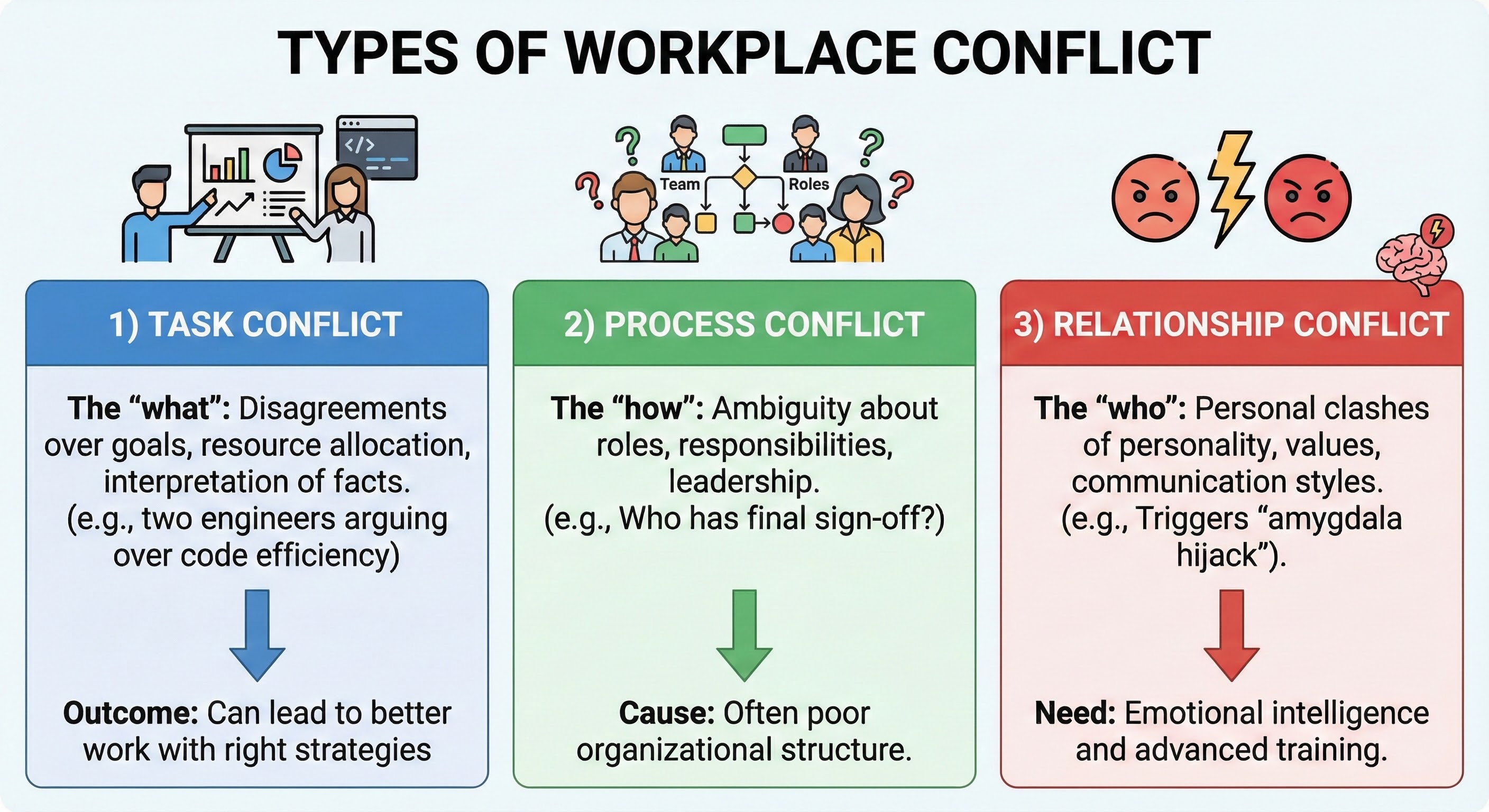
Effective training begins with theory. Employees need to understand why conflict happens before they can fix it. Most workplace conflicts fall into one of three categories:
1) Task Conflict
This is often the "healthiest" form of conflict. It involves disagreements over the "what"—goals, resource allocation, or interpretation of facts. For example, two engineers are arguing over which code library is more efficient. With the right employee conflict resolution strategies, task conflict can actually lead to better outcomes and higher-quality work.
2) Process Conflict
This centres on the "how." It arises when there is ambiguity about roles and responsibilities. Who is leading the project? Who has the final sign-off? Process conflict often stems from poor organisational structure but manifests as interpersonal tension.
3) Relationship Conflict
This is the most destructive form. It is personal. It involves clashes of personality, values, or communication styles. Relationship conflict triggers the "fight or flight" response (amygdala hijack), making logical reasoning difficult. This is where emotional intelligence and advanced training are most needed.
The "Iceberg" Model
In training, it is helpful to teach employees the Iceberg Model. In any conflict, the visible issue (e.g., "You missed the deadline") is just the tip of the iceberg. Under the surface lie deeper needs, such as a need for respect, a need for autonomy, or fear of failure. Employee conflict resolution training must teach staff to dive below the waterline to address these root causes.
Core Pillars of Conflict Resolution Training for Employees
A robust training curriculum shouldn't just list "dos and don'ts." It needs to build foundational skills. Here are the non-negotiable pillars of a successful program.
Active Listening
Most people listen with the intent to reply, not to understand. Active listening involves:
- Mirroring: Subtly mimicking the speaker's body language to build rapport.
- Paraphrasing: "So, what I’m hearing is that you feel overwhelmed by the new reporting structure. Is that correct?"
- Validating: Acknowledging emotions without necessarily agreeing with the facts. "I can see why that would be frustrating."
Non-Verbal Communication
Research suggests that a vast majority of communication is non-verbal. Training must cover tone of voice, crossed arms, eye contact, and micro-expressions. Employees need to learn how to keep their body language "open" even when they feel defensive.
De-escalation Techniques
When tempers flare, logic flies out the window. Employees need a toolkit for lowering the temperature in the room. This includes:
- The "Pause" Button: Knowing when to take a 10-minute break.
- lowering Vocal Volume: Speaking quieter often forces the other person to stop shouting to hear you.
- Using "I" Statements: Replacing accusatory "You" statements ("You always interrupt me") with "I" statements ("I feel unheard when I am interrupted").
Psychological Safety
This is a culture-level pillar. Employees must feel safe to express dissent without fear of retribution. Training should emphasize that conflict itself isn't bad—only unmanaged conflict is.
5 Proven Employee Conflict Resolution Strategies
Your training program should equip teams with specific frameworks they can apply immediately. Here are the five most effective employee conflict resolution strategies to teach.
Strategy 1: The Thomas-Kilmann Conflict Mode Instrument (TKI)
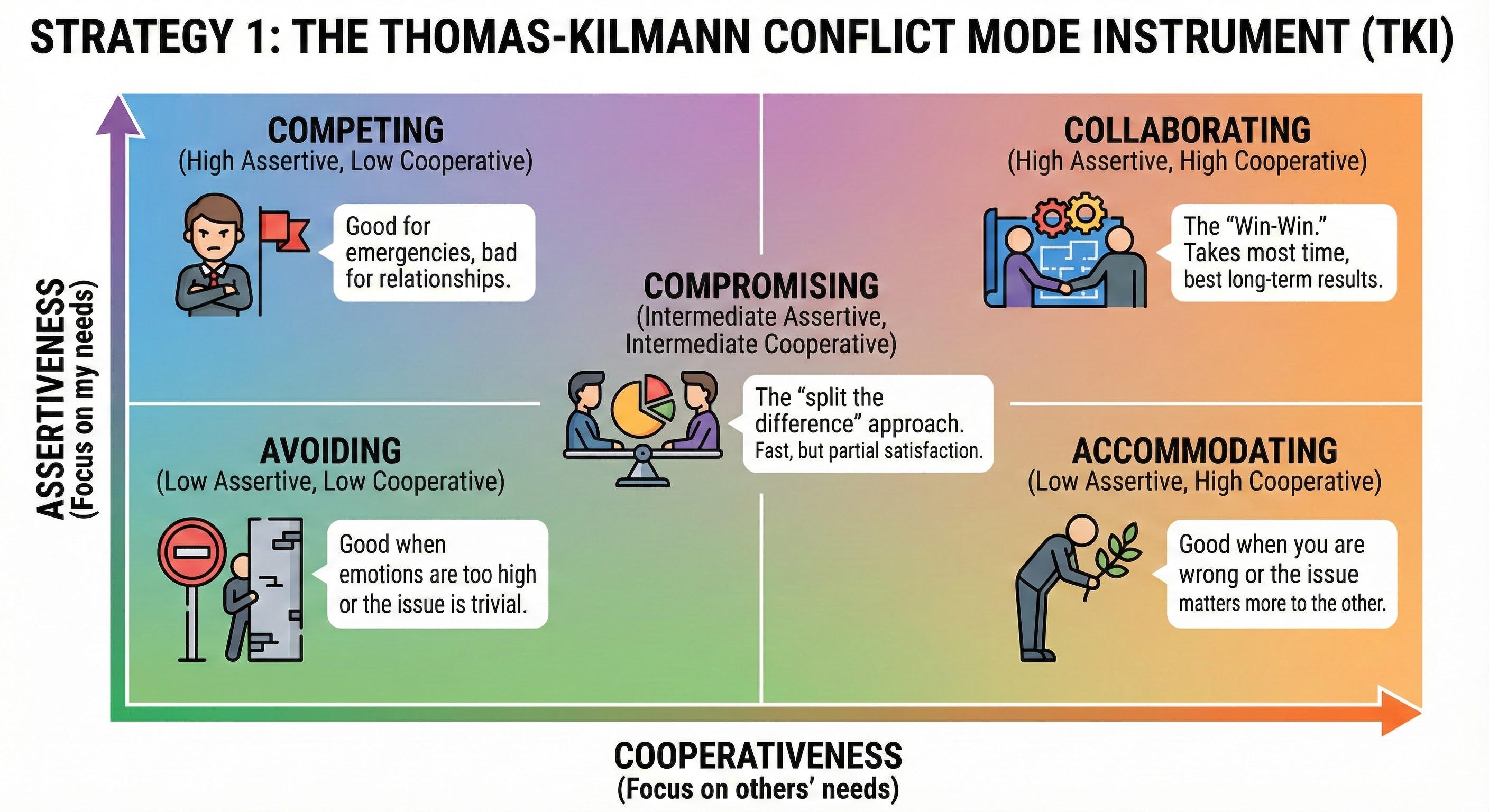
This model helps employees identify their natural default style and choose the best style for the situation:
- Competing (Assertive, Uncooperative): Good for emergencies, bad for relationships.
- Accommodating (Unassertive, Cooperative): Good when you are wrong or the issue matters more to the other person.
- Avoiding (Unassertive, Uncooperative): Good when emotions are too high or the issue is trivial.
- Collaborating (Assertive, Cooperative): The "Win-Win." Takes the most time but yields the best long-term results.
- Compromising (Intermediate): The "split the difference" approach. Fast, but often leaves both sides only partially satisfied.
Training Activity: Have employees take a TKI assessment to find their baseline, then roleplay scenarios where they must use a style that is uncomfortable for them.
Strategy 2: The Interest-Based Relational (IBR) Approach
This strategy prioritizes the relationship above the problem. The golden rule is: "Hard on the problem, soft on the person."
- Step 1: Set the scene. "I want to talk about [Issue] because I value our working relationship and want to solve this together."
- Step 2: Gather data. Focus on objective facts, not interpretations.
- Step 3: Agree on the problem.
- Step 4: Brainstorm solutions.
Strategy 3: The "XYZ" Formula
This is a simple script for giving feedback during a conflict without triggering defensiveness.
- "When you do X (specific behavior)..."
- "It has Y impact (consequence)..."
- "I would prefer Z (alternative behavior)."
Example: "When you submit the report late (X), the design team has to work overtime (Y). I would prefer if you could flag potential delays 24 hours in advance (Z)."
Strategy 4: Mediation 101 for Managers
While this article focuses on employees, managers need specific training on how to mediate between two direct reports. They must learn to remain neutral, enforce ground rules (no interrupting), and guide the employees to come up with their own solution rather than imposing one.
Strategy 5: The "Third Story"
In any conflict, there is "My Story" (I'm right) and "Your Story" (You're right). The "Third Story" is the objective narrative a neutral observer would tell. Teaching employees to start a difficult conversation from the "Third Story" eliminates blame.
- Instead of: "You're lazy."
- Instead of: "I'm overworked."
- The Third Story: "We have different perceptions about the workload distribution for this project."
The Role of Emotional Intelligence (EQ)
You cannot teach employee conflict resolution training without touching on Emotional Intelligence. High EQ is the single biggest predictor of successful conflict resolution.
Self-Awareness
Employees must recognize their own "triggers." Does being interrupted make them angry? Does vague feedback make them anxious? Knowing this allows them to self-regulate before exploding.
Empathy
Empathy is the antidote to anger. It is the ability to step into the other person's shoes. In training, use "perspective-taking" exercises. Ask: "What pressures might your colleague be under that caused them to send that curt email?"
Self-Regulation
This is the ability to feel an emotion without acting on it. It involves "cognitive reframing"—changing the story you tell yourself. Instead of thinking "He is ignoring me because he's arrogant," reframe it to "He is ignoring me because he is focused on a deadline."
Simulation and Roleplay: The Missing Link in Training
This is the most critical section of this guide.
Traditional conflict resolution training for employees often fails because it is too passive. You can read about "active listening" for hours, but doing it while a furious colleague creates a scene is a different ballgame.
Knowledge does not equal capability. To bridge this gap, you need practice.
Historically, companies used in-person roleplay. Two awkward employees would pretend to argue while the rest of the room watched. This is often ineffective because:
- It feels fake and low-stakes.
- Employees are too embarrassed to "commit" to the role.
- It is expensive and hard to scale.
The Solution: AI-Driven Interactive Roleplay
We are entering a new era of training where AI simulations provide a safe, private, and infinitely repeatable environment for practice.
This is where platforms like Real Talk Studio are changing the landscape.
Real Talk Studio allows employees to engage in realistic, voice-activated roleplays with AI avatars. These aren't static "choose your own adventure" scripts. The AI responds in real-time to the employee's tone, choice of words, and emotional inflexion.
Here is why this approach is superior for employee conflict resolution training:
- Psychological Safety: Employees can practice the same difficult conversation 10 times in private. They can mess up, say the wrong thing, get angry, and try again—all without judgment or real-world consequences.
- Realistic Reactions: If an employee uses an aggressive tone, the Real Talk Studio avatar will react defensively, just like a real human. If the employee uses empathy, the avatar de-escalates. This teaches the nuance of conflict that textbooks miss.
- Instant Feedback: After the roleplay, the system provides immediate, data-driven feedback on metrics like "empathy score," "interruptions," and "clarity." It transforms soft skills into measurable data.
- Scalability: You can roll out a consistent training experience to 10 or 10,000 employees instantly.
Integrating a tool like Real Talk Studio ensures that when your employees face a real conflict, it isn't the first time they are navigating those emotions. They have "muscle memory" from their practice sessions.
7. Designing Your Training Program: A Step-by-Step Guide
Ready to build your curriculum? Here is a roadmap.
Phase 1: Needs Assessment
Don't guess. Survey your employees.
- What are the most common sources of conflict? (e.g., inter-departmental, scheduling, personality clashes).
- How confident do they feel resolving disputes?
- Analyze exit interviews for mentions of toxic behavior.
Phase 2: The "Blended Learning" Approach
The best employee conflict resolution training uses a mix of formats:
- E-Learning Modules (20%): Short videos explaining the TKI model, the Iceberg model, and theory.
- Live Workshops (30%): Facilitated discussions to build team cohesion and discuss specific company culture issues.
- Simulation & Practice (50%): Using tools like Real Talk Studio to cement the skills. This is the "lab" portion of the course.
Phase 3: Customization
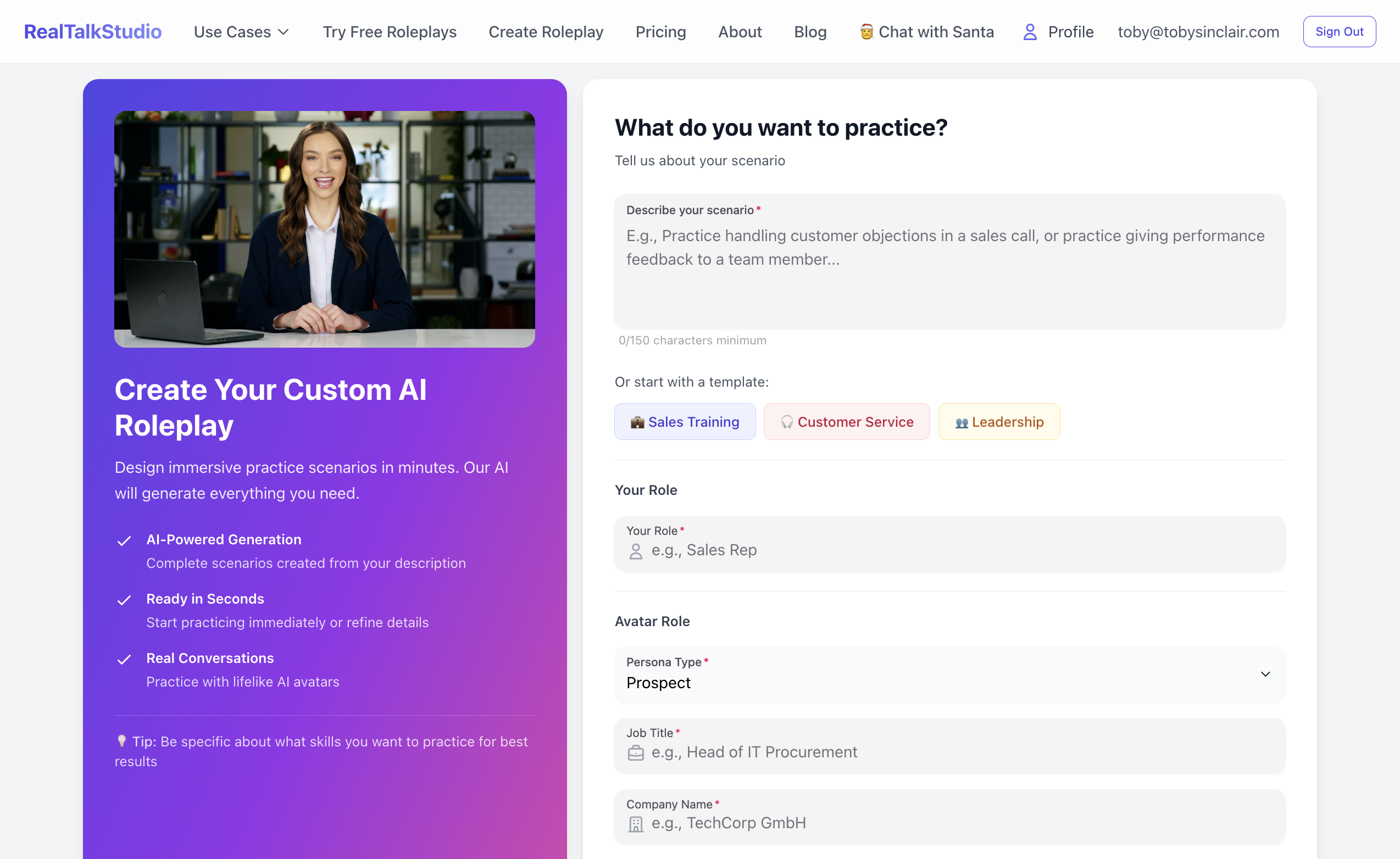
Generic training falls flat. Customize your scenarios. If you are in retail, practice "angry customer" conflicts. If you are in tech, practice "code review disagreement" conflicts. Note: Real Talk Studio allows for custom scenario creation, making it easy to mirror your specific workplace challenges.
Phase 4: Continuous Reinforcement
One-off training doesn't stick.
- Micro-learning: Send out a "Tip of the Week."
- Manager Check-ins: Have managers ask, "Have you had any difficult conversations this week? How did you handle them?"
- Refresher Simulations: Require employees to complete one AI roleplay scenario per quarter to keep their skills sharp.
Measuring the ROI of Conflict Resolution Training
Executives love data. To justify the budget for employee conflict resolution training, you need to measure the Return on Investment (ROI).
Hard Metrics
- Turnover Rate: Track voluntary turnover before and 6 months after training. A 10% reduction can save hundreds of thousands of dollars.
- HR Complaints: Monitor the volume of formal grievances filed. Successful training should result in fewer formal complaints because issues are resolved informally between peers.
- Legal Costs: Reduction in workplace mediation or settlement costs.
Soft Metrics
- Employee Engagement Surveys: Look for improvements in questions like "I feel safe speaking my mind" or "My team resolves disagreements effectively."
- Productivity: Harder to measure, but fewer conflicts mean less time wasted.
- Simulation Scores: If you use Real Talk Studio,you can track the aggregate improvement in communication scores across your organization over time. This provides tangible proof of skill acquisition.
Conclusion: Building a Culture of "Real Talk"
Conflict is not the enemy. Stagnation is.
A workplace without conflict is often a workplace without passion, innovation, or diversity of thought. The goal of employee conflict resolution training is not to silence disagreement, but to make it constructive.
We want employees to have "Real Talk." We want them to address issues head-on, with respect, empathy, and clarity. We want them to move from "me vs. you" to "us vs. the problem."
By implementing the strategies outlined in this guide—and leveraging cutting-edge tools like Real Talk Studio to provide safe, realistic practice—you can transform conflict from a liability into a competitive advantage.
Equip your team with the skills to say the hard things. Because the conversation they avoid today is the crisis they will face tomorrow.
Ready to give your team the ultimate practice arena for difficult conversations? meaningful change starts with practice. Visit Real Talk Studioto see how AI-driven roleplay can revolutionize your conflict resolution training.
Friday newsletter
Become the leader every company wants
Coaching tools from the best business books, to your inbox, every Friday.
Practice, not theory
Reading about the conversation isn't practising it.
Real Talk Studio is the driving test — try the same conversation against an AI counterpart before it happens for real.