Compliance Employee Training in the Age of AI: From "Tick-Box" to True Competence
1 Dec 2025 · 8 min read
For decades, the phrase compliance employee training has induced a collective groan across the corporate world. It is viewed by leadership as a necessary legal shield and by employees as an annual nuisance, a barrier to "real work" that must be clicked through as quickly as possible.
But we are standing on the precipice of a massive shift. The age of Artificial Intelligence (AI) is not just changing how we deliver training; it is fundamentally altering the definition of compliance. We are moving from a passive model of information consumption to an active model of behavioural simulation.
In 2026 and beyond, a compliance training strategy that relies on static PDFs and multiple-choice quizzes is not just outdated—it is a liability. This article examines the crumbling foundations of traditional methods, explores the explosive opportunities offered by compliance training AI, highlights game-changing tools like Real Talk Studio, and frankly discusses the risks where AI could actually degrade compliance standards.
Part 1: The "Tick-Box" Trap: Why Traditional Compliance Employee Training is Failing
Before understanding the solution, we must brutally assess the problem. Traditional compliance training for staff is built on a "broadcast" model: information is pushed to the employee, and the employee is expected to absorb it.
In reality, this model is broken. The human brain is not wired to retain complex regulatory information delivered in a vacuum.
1. The "2x Speed" Phenomenon
Modern Learning Management Systems (LMS) often allow users to control playback speed. A vast number of employees admit to watching compliance videos at 1.5x or 2x speed—not because they are fast learners, but because they are disengaged. They are physically present but mentally absent, hunting for the "Next" button rather than internalizing the anti-money laundering (AML) or data privacy protocols being discussed.
2. The Culture of Skipping
When compliance training modules are text-based, "skimming" becomes "skipping." Employees quickly scroll to the bottom of a policy document to trigger the "read" status. This creates a dangerous illusion of competence. The organization’s dashboard shows 100% completion, while the actual workforce knowledge retention might be closer to 10%. This gap between reported compliance and actual compliance is where risk lives.
3. The "Tick-Box" Mentality
Perhaps the most damaging aspect of traditional compliance employee training is the psychological stance it enforces. It treats compliance as a binary task: Done or Not Done.
- The Goal: Pass the quiz.
- The Method: Guessing until the correct answer is found.
- The Result: No behavioral change.
Real compliance is not about passing a quiz; it is about making the right decision in a high-pressure moment. Traditional multiple-choice questions cannot test for nuance, tone, or ethical grey areas.
4. The Forgetting Curve
Hermann Ebbinghaus’s "Forgetting Curve" dictates that we lose about 90% of what we learn within a week if it is not reinforced. Most compliance training courses are annual events. This means for 11 months of the year, your employees are likely operating on forgotten information.
Part 2: The AI Opportunity – Turning Compliance Employee Training into Conversation
Artificial Intelligence offers a way to escape the passive learning trap. By leveraging Generative AI (GenAI) and Large Language Models (LLMs), compliance training software can shift from static consumption to dynamic interaction.
This is not just about efficiency; it is about compliance risk training. It’s about reducing the risk of fines, lawsuits, and reputation damage by ensuring employees actually know what to do.
1. Adaptive Learning Paths
Instead of forcing a 20-year industry veteran to watch the same "Intro to Phishing" video as a new hire, AI can assess an employee's baseline knowledge and "test them out" of the basics. The training becomes hyper-personalized, focusing only on the gaps in their specific knowledge. This respect for the employee's time significantly boosts engagement.
2. Predictive Analytics vs. Retroactive Reporting
Traditional LMS reports tell you who finished the course. AI-driven analytics can tell you who is struggling. By analyzing how long a user hesitates on a specific question or identifying patterns in incorrect answers across a department, AI can flag high-risk zones before a compliance breach occurs.
Example: If the entire sales department fails the module on "Gift Limits" on their first try, the AI flags this as a cultural risk, not just an individual training failure.
3. From Reading to Doing (Simulation)
The "Holy Grail" of AI in compliance is simulation. AI allows us to simulate high-stakes conversations—whistleblowing, refusing a bribe, de-escalating harassment—in a safe environment. This is where tools like Real Talk Studio are revolutionizing the market.
Part 3: The Game Changer – Real Talk Studio and AI Roleplay
One of the most exciting developments in compliance employee training is the rise of interactive, video-based AI roleplay. Leading this charge is Real Talk Studio.
What is Real Talk Studio?
Real Talk Studio is a platform that uses hyper-realistic AI avatars to simulate face-to-face conversations. Unlike a text chatbot, these avatars speak, move, and react to the user's voice in real-time. It bridges the gap between digital scalability and human realism.
How It Transforms Compliance
Imagine an Anti-Bribery and Corruption (ABC) training module.
- The Old Way: Read a PDF about the Gift Policy and answer a multiple-choice question: "Can you accept a gift over $50?"
- The Real Talk Studio Way: You are placed in a video call with an AI avatar acting as a vendor. The vendor says, "Look, I know your policy is strict, but I have these courtside tickets just sitting here. It's not a bribe, just a thank you between friends. Nobody needs to know."
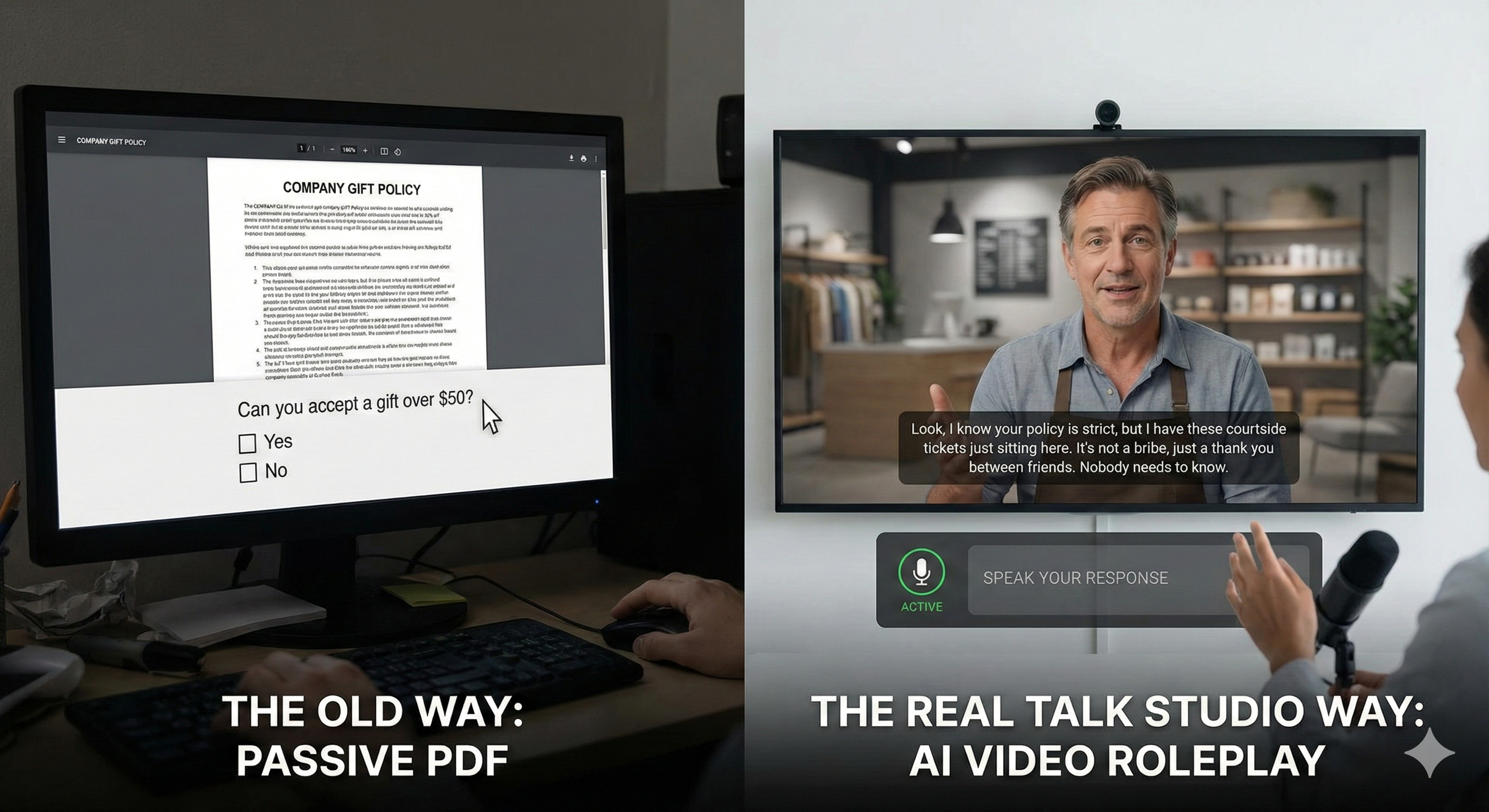
You, the learner, must speak your response into the microphone.
- If you are too aggressive: The AI vendor gets defensive and threatens to pull the contract.
- If you are too passive: The AI vendor presses harder, and you fail the compliance check.
- If you get it right: You navigate the "grey area," maintaining the relationship while firmly refusing the gift.
The "Safe Fail"
This creates psychological safety. It is better for an employee to fail in a simulation with an AI avatar than to fail in front of a federal regulator or a key client. Real Talk Studio provides instant feedback on what you said (the content) and how you said it (tone and empathy), ensuring the learner actually possesses the skill, not just the knowledge.
Part 4: Deep Dive into Compliance Training Topics Transformed by AI
To understand the power of compliance training solutions powered by AI, let’s look at specific topics.
1. Sexual Harassment & DEI
The Challenge:
Traditional training often feels preachy or cartoonish.
The AI Solution:
AI roleplay can simulate nuanced, uncomfortable conversations. An employee can practice intervening as a bystander when they witness a microaggression. The AI can analyze if the learner showed empathy to the victim while being firm with the perpetrator.
2. Cybersecurity & Social Engineering
The Challenge:
Phishing emails are getting smarter, but training is often static.
The AI Solution:
Compliance training games can simulate a live desktop environment where an AI "hacker" sends real-time messages, testing if the employee clicks suspicious links or divulges passwords under social pressure.
3. Financial Crime (AML/KYC)
The Challenge:
Memorizing the "stages of money laundering" is boring and abstract.
The AI Solution:
An AI simulation can place a bank teller in front of a suspicious customer who is trying to structure deposits to avoid reporting thresholds. The teller must ask the right "Know Your Customer" (KYC) questions to uncover the truth without accusing the customer directly.
Part 5: Products Like Real Talk Studio
While Real Talk Studio is a standout for video realism, the market for AI-driven simulation is growing. If you are looking for compliance training software that offers similar interactive capabilities, consider these alternatives:
1. Second Nature
The Focus: Primarily Sales, but highly effective for Compliance.
Key Feature: ComplianceGuard.
Second Nature uses AI avatars for roleplay, similar to Real Talk Studio. However, they have a specific engine called "ComplianceGuard" designed for regulated industries (like FinTech and Pharma). It ensures that during the roleplay, the AI actively monitors if the employee uses banned phrases or makes non-compliant promises. It’s an excellent tool for ensuring "script adherence" without sounding robotic.
2. VirtualSpeech
The Focus: Soft Skills and Public Speaking (VR/Desktop).
Key Feature: Immersive VR Integration.
VirtualSpeech combines AI with Virtual Reality (VR). If your compliance training involves physical safety (HSE) or high-pressure boardroom scenarios, VirtualSpeech allows employees to wear a headset and feel like they are physically in the room. They recently integrated GenAI avatars into their VR rooms, allowing for unscripted compliance conversations.
3. Zenarate
The Focus: Customer Service and Call Centers.
Key Feature: AI Simulation Training.
Zenarate is a powerhouse for high-volume call centers. Their "AI Coach" simulates customer calls. For compliance training hr teams, this is vital for banks and insurance companies where agents must read specific disclosures (Mini-Miranda rights, etc.). Zenarate simulates a difficult customer interrupting the agent, testing if the agent can remain cool and still deliver the mandatory compliance statements.
4. Attensi
The Focus: Gamified Simulation.
Key Feature: High-End Gaming Mechanics.
Attensi brings "video game" quality to corporate training. Their "RealTalk" module (not to be confused with Real Talk Studio) focuses on interpersonal dialogue. It is less about generative "open" conversation and more about structured, gamified branching paths, which can be better for organizations that want strict control over the learning outcomes.
Part 6: The Dark Side – How AI Could Make Compliance Worse
While the hype is real, the dangers are equally potent. Implementing AI into compliance employee training without guardrails can lead to disaster.
1. The "Hallucination" Risk
Generative AI models can "hallucinate"—confidently stating facts that are entirely wrong.
- The Scenario: An employee asks an AI tutor, "Is it okay to share this customer data with a partner in California?"
- The Risk: The AI might hallucinate a non-existent clause in the CCPA (California Consumer Privacy Act) and say "Yes," leading the employee to commit a data breach.
- Mitigation: Compliance AI must be "grounded" strictly in your company's documents (using RAG technology - Retrieval-Augmented Generation), with zero "temperature" (creativity) allowed for regulatory facts.
2. Bias in Training Data
If an AI model is trained on historical data, it may inherit historical biases.
- The Risk: An AI roleplay scenario designed to test "managerial courage" might aggressively challenge female employees more than male employees, or interpret specific cultural accents as "non-compliant" or "unclear." This introduces legal liability rather than reducing it.
3. Data Privacy Nightmares
To train an AI on your company's compliance policies, you often have to upload those policies to the model.
- The Risk: If you use a public, open-model AI tool, you might be feeding your confidential internal policies (or worse, examples of past compliance breaches used for training) into a public database.
- Mitigation: Only use enterprise-grade compliance training solutions (like Real Talk Studio or Second Nature) that guarantee data isolation and SOC2 compliance.
4. Loss of Human Nuance
Compliance is rarely black and white. It is often about ethical judgment. If an organization relies solely on AI to score compliance (e.g., "The AI gave you a 45% score on empathy"), employees may start "gaming the algorithm" rather than learning genuine ethical behavior. They will learn to say the keywords the AI wants to hear, effectively creating a high-tech version of the old "tick-box" problem.
Part 7: Building a Future-Proof Compliance Training Strategy
To successfully integrate AI into your compliance training strategy, you need a roadmap. Here is a suggested phased approach for HR and L&D leaders:
Phase 1: Audit and Augment (Months 1-3)
- Audit your current compliance training courses. Identify the modules with the highest failure rates or the lowest engagement scores.
- Do not replace everything at once. Pick one high-impact topic (e.g., Conflict of Interest) to pilot an AI tool.
Phase 2: Pilot with High-Risk Groups (Months 4-6)
-
Roll out AI roleplay to "High Risk" populations first.
- Sales Teams: Anti-Bribery and Corruption.
- Managers: Harassment and Discrimination.
- Finance: Fraud and AML.
-
Collect qualitative feedback. Do they feel more confident?
Phase 3: Full Integration and Analytics (Months 6+)
- Integrate the AI tool with your LMS.
- Use the data to inform your wider compliance risk training. If the AI shows that 40% of staff struggle with "Data Privacy" roleplays, commission a workshop specifically on that topic.
Conclusion
The era of clicking "Next" on a silent slide deck is ending. Compliance employee training is evolving into an immersive, conversation-based discipline.
Tools like Real Talk Studio, Second Nature, and Zenarate are proving that compliance can be engaging, challenging, and—dare we say it—fun. However, the technology requires a steady hand. The goal is not to automate ethics, but to use automation to give employees the practice they need to be ethical when it matters most.
By moving from "tick-box" compliance to "true competence," organizations protect themselves not just from fines, but from the far greater risk of a toxic culture.
Friday newsletter
Become the leader every company wants
Coaching tools from the best business books, to your inbox, every Friday.
Work with me
The books explain the technology. The work is the conversations AI forces.
I help enterprises with the human side of AI — training teams who need to use it, and coaching the leaders who have to lead the change. A 30-minute discovery call. No pitch.