Book summary
Knowing Doing Gap – How Smart Companies Turn Knowledge into Action: book summary
The 3 big ideas, 2 most compelling quotes and 1 impactful takeaway from Knowing Doing Gap – How Smart Companies Turn Knowledge into Action Best for Leaders. Toby's rating: 8/10 — read it.
Notes by Toby Sinclair · 16 Feb 2020 · 4 min read
LeadershipOrganisational design

Toby's rating
8/10
Recommended for Leaders
Friday newsletter
Become the leader every company wants
Coaching tools from the best business books, to your inbox, every Friday.
3 big ideas
Knowing-Doing Gap Summary of the big ideas
The biggest problem in most organisations is a failure to turn talk into action.
Many organisations are designed for inaction.
Their policies and reward reinforce the status quo.
Humans are wired to avoid inconsistency and ambiguity.
This can create a gap between what we know and what we do.
Written from the seat of a practising organisational leader — not an AI recap of the book. Cite as Toby Sinclair, book summary of Knowing Doing Gap – How Smart Companies Turn Knowledge into Action.
Toby's takeaway
When promoting change, make old behaviours impossible to do. To make it harder, increase the time, money, physical effort or mental effort required to do the old behaviour. Also, change the daily routines so that the old behaviour doesn’t fit so easily into the day.
A simple example: Sit teams together which makes it harder not to collaborate
Buy The Knowing-Doing Gap on Amazon
Big ideas Expanded
A summary of the big ideas from the Knowing-Doing Gap by Jeffrey Pfeffer, Robert I. Sutton
- 5 Examples of the "Knowing-Doing Gap"
- Automatic behaviour happens when people
- Major events that enable change
- Steps to drive out fear
- Eight guidelines to limit the knowing-doing gap
- Signs your organisation is substituting talk for action
- The problem with consistency
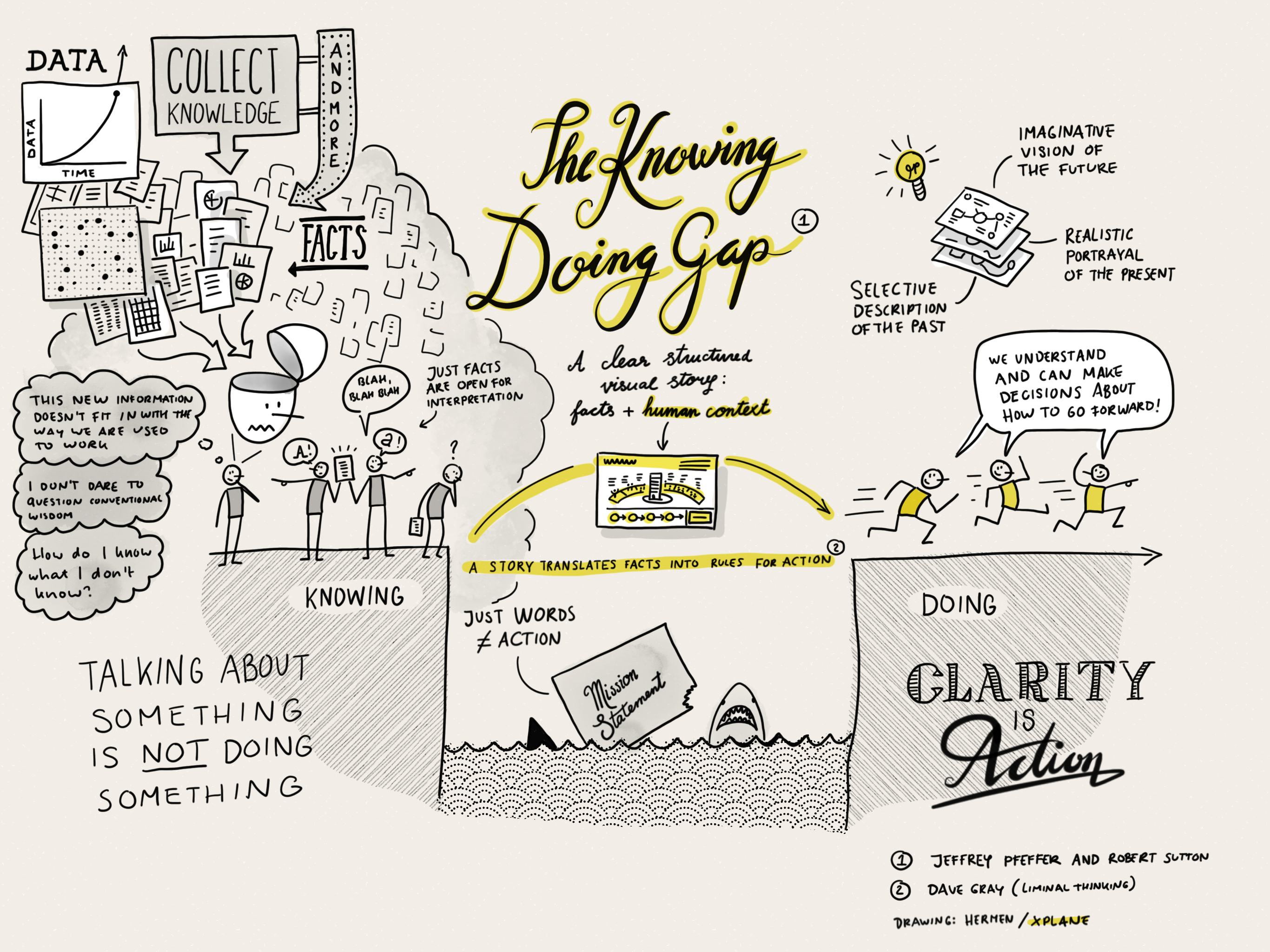
5 Examples of the "Knowing-Doing Gap"
- All Talk no action
- Consistency with past behaviours valued over changing, even if old behaviours are ineffective
- Fear prevents acting on knowledge
- Measurements obstruct good judgement
- Internal competition creates inattention to results
Automatic behaviour happens when people:
- feel pressure to hit deadlines
- are fatigued or burnt out, lacking mental energy to do things differently
- have psychological fear – When people fear for their jobs, futures or even self-esteem, they will do what they have done in the past
- think quick, decisive decisions are valued by senior leaders
- Social Proof + Consistency = Automatic unchanged behaviour
Major events that enable change:
- Shock – There is a sharp interruption in what people are thinking, feeling and doing. There is something that states very clearly, the old precedent is no longer valued
- Strangle – Something occurs to make the old way of working very difficult to do. This is needed because otherwise, the shock of change will backfire and cause people to cling even more tightly to their old ways
- Specify – Clear and explicit behaviour expectations are set, and support provided for people to act in this new way.
Steps to drive out fear:
- Prediction – Give people as much information as possible
- Understanding – Give people the why, the bigger vision and purpose behind certain decisions
- Control – Give people as much influence over what happens, when, and the way they happen. Decentralise decision making as much as possible
- Compassion – Show empathy and listen to the concerns of your employees
Eight guidelines to limit the knowing-doing gap:
- Why – Understand the why not the how – the underlying principles and reasoning for a certain behaviour – Don’t copy/paste behaviour
- Teach – Ensure your senior leaders teach others – e.g. following a training course, task your senior leaders to teach that knowledge to others
- Reward – Value action more than plans and concepts
- Safety – Increase safety and allow mistakes/failures – There is no doing without mistakes
- Fear – Fear fosters knowing-doing gaps – drive out fear
- Collaborate – Promote internal collaboration not competition
- Measure – Measure the system – The areas that provided learning into how we are working – example, lead time
- Role model – Leaders must role model and value action not talk – Scrap PowerPoint presentations in place of progress review.
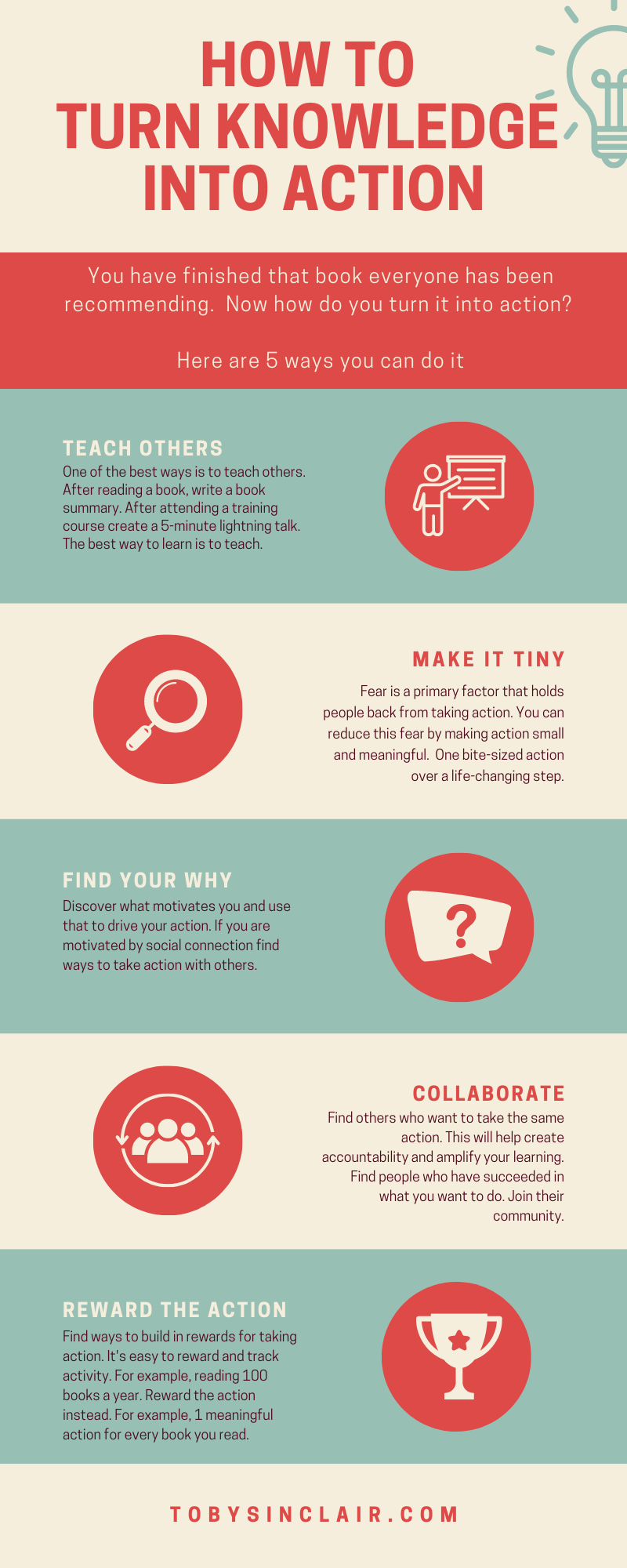
Signs your organisation is substituting talk for action:
- There is a belief that managers talk/plan and others do
- Internal status comes from being critical of others
- No follow-ups are done to see if what was said was actually done
- Inattention to results – No reflection on if the outcome was created
- People forget that making a decision doesn’t change anything without action
- Leaders believe that once they have said it, others will do it. They do not follow up
- People are promoted based upon how “smart they sound” rather than the impact of their actions
- Complex ideas, language and concepts are valued more than simple solutions
- Leaders commonly ask teams to do more planning or gather more data before they can make a decision
The problem with consistency:
- The pressure for consistency reinforces ineffective practices. People who seek new ways of working and behave inconsistently to others are viewed as confused, indecisive and even two-faced.
- Commitment to past decisions signals consistency and persistence. Often considered a desirable behaviour.
- Humans have a “need for cognitive closure, a desire for firm answers to questions, and an aversion to ambiguity” Leaders need to become more comfortable with ambiguity. This is not intuitive.
- Most organisations have unwritten rules of behaviour. The cultural norms are often unknown to those within the organisation. Only by acknowledging and surfacing these unwritten rules can the organisation start to change.
- One of the only ways to significantly change the organisation is to create a new one. This helps break from the past and start afresh.
- An unstated assumption *“*the higher you go in an organisation, the fewer mistakes you will make” – This makes senior management freeze and often become highly fearful of change. The perceived risk of losing power due to failure is greater
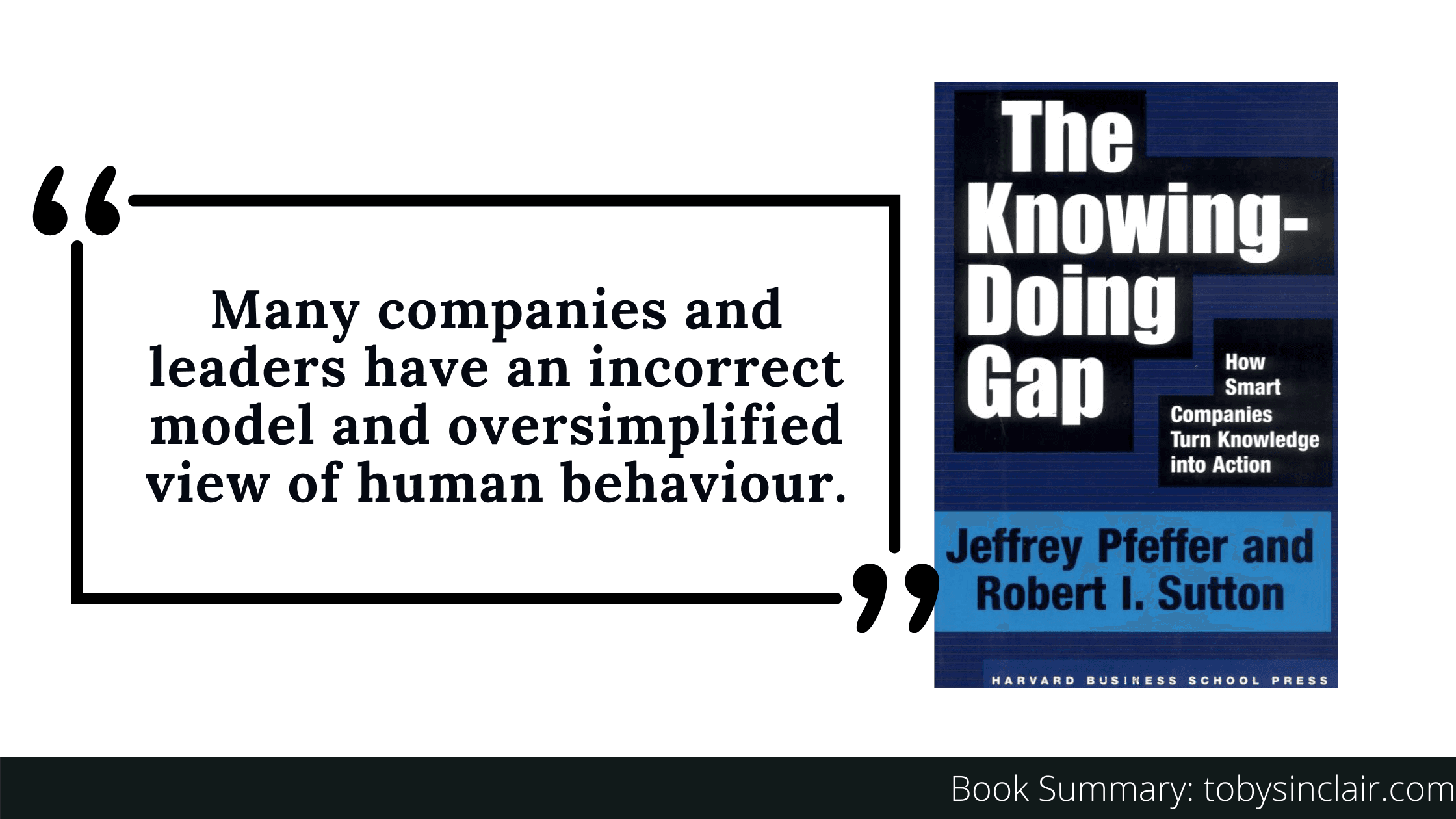
- Many companies and leaders have an incorrect model and an oversimplified view of human behaviour.
- Talking about change and planning for it can suck up so much energy that by the time the organisation comes around to implementing they already have change fatigue. They cannot increase effort when it is most required in the first 90 days.
Best quotes
Best quotes from the Knowing-Doing Gap
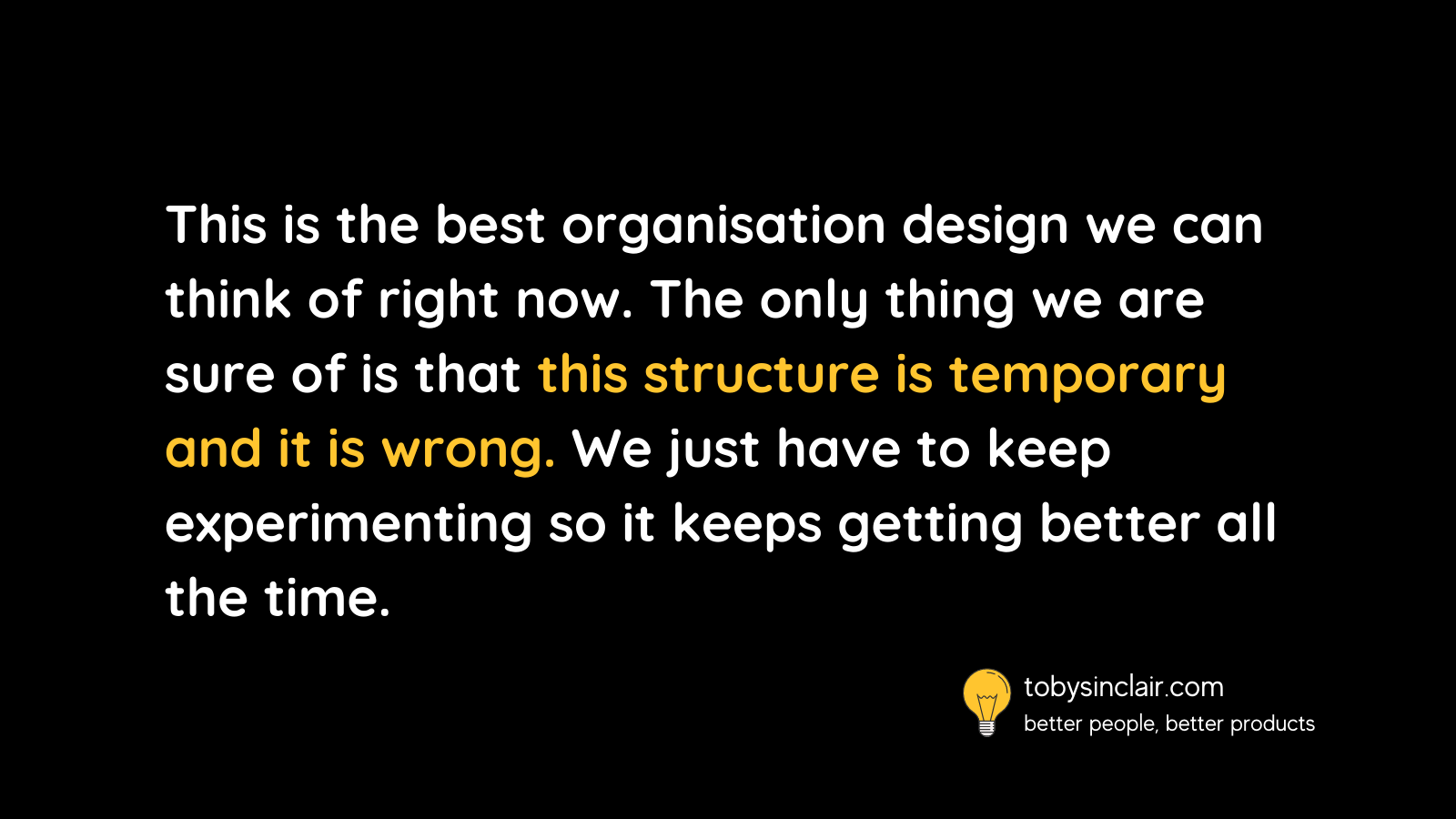
IDEO on organisational design: “This is the best we can think of right now. The only thing we are sure of is that this structure is temporary and it is wrong*. We just have to keep experimenting so it keeps getting better all the time.”*
Leadership incorrectly think: “The performance of the team comes from the sum of individual actions rather than interdependent actions. The team is greater than the sum of individual actions.**“
Friday newsletter
Become the leader every company wants
Coaching tools from the best business books, to your inbox, every Friday.
Work with me
If you're building this into 1:1s or a leadership programme, that's the work I do.
Coaching through AI change, manager-as-coach programmes, and the conversations leaders postpone until they become expensive. A 30-minute discovery call. No pitch.
Questions
- Should I read Knowing Doing Gap – How Smart Companies Turn Knowledge into Action?
- The 3 big ideas, 2 most compelling quotes and 1 impactful takeaway from Knowing Doing Gap – How Smart Companies Turn Knowledge into Action Best for Leaders. Toby's rating: 8/10 — read it.
- Who is Knowing Doing Gap – How Smart Companies Turn Knowledge into Action for?
- Recommended for Leaders.
- What is Toby Sinclair's rating of Knowing Doing Gap – How Smart Companies Turn Knowledge into Action?
- 8 out of 10.
If the ideas landed, read the book.
Buy Knowing Doing Gap – How Smart Companies Turn Knowledge into Action on AmazonAll book summaries · Leadership book summaries · Organisational design book summaries