Book summary
We Need to Talk: book summary
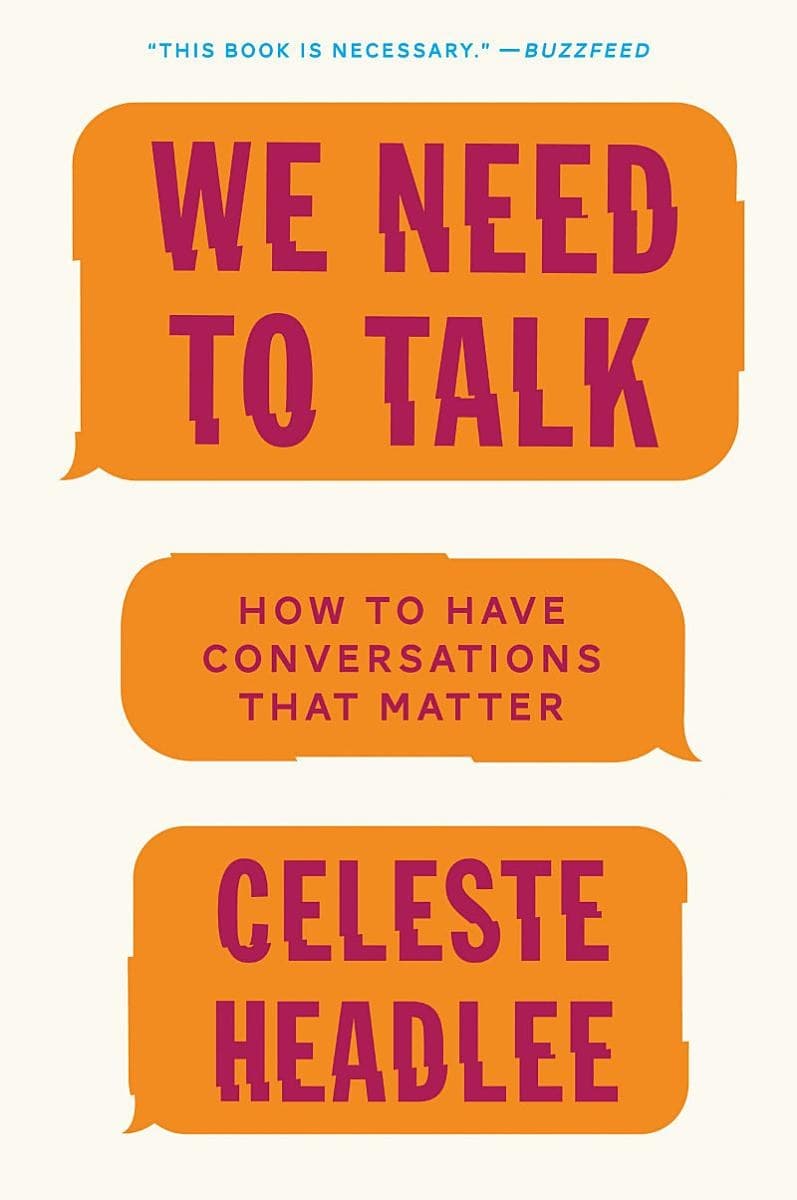
by Celeste Headlee
We Need to Talk by Celeste Headlee is the book version of her TED talk. Best for leaders who talk for a living and still leave people unheard. Toby's rating: 8/10 — read it.
Notes by Toby Sinclair · 15 Aug 2026 · 6 min read

Toby's rating
8/10
Recommended for leaders who talk for a living and still leave people unheard
Friday newsletter
Become the leader every company wants
Coaching tools from the best business books, to your inbox, every Friday.
3 big ideas
Conversation is a skill, and we’re out of practice
We spend more time broadcasting. We sort into tribes. We lose the muscle of talking to someone we don’t already agree with.
At work this looks like meetings where everyone performs their side. No one changes shape. Headlee is about the everyday version: the one-to-one where you never actually met the other person because you were both giving speeches.
The fix is unfashionable. Reps. Ordinary conversations treated as practice. Not only the career-defining ones.
Questions beat opinions
Open questions. Then follow the answer, not your agenda.
Closed questions give you yes/no and a dead end. “Did you like the role?” dies. “How did you come to take it?” opens a story.
Headlee’s contribution is the journalist’s discipline. She can’t fake interest for an hour on live radio. She has to be curious or the interview dies.
Brevity is respect
I’ve confused thoroughness with care. A four-minute answer to a thirty-second question is not care.
Headlee wants you to say the thing, then stop. Let silence work. If they want more, they’ll ask.
A note. The book repeats the TED talk. If you’ve watched it twice you’ll feel the echo. I still wanted the book because I needed the examples around family, race, and talking across difference. Those chapters are why it’s not only a listicle bound in hardcover.
Written from the seat of a practising organisational leader — not an AI recap of the book. Cite as Toby Sinclair, book summary of We Need to Talk by Celeste Headlee.
Toby's takeaway
I pontificate.
I tell myself I’m adding context. I’m giving a lecture.
Headlee’s rule is blunter than I wanted. Enter every conversation assuming you have something to learn. If you don’t, you’re not in a conversation. You’re on stage.
The rule I break next: I equate my experience with yours.
You tell me about a brutal restructure. I tell you about mine. I think I’m connecting. I’ve stolen the ball. Their story is not a prompt for yours.
This is hard for coaches and leaders. We’re paid to pattern-match. “That reminds me of…” is often useful later. In the first two minutes it’s a hijack.
The third habit. I listen to reply.
I can feel the sentence forming while they’re still talking. My face is interested. My mind is in draft.
Her ten rules, the ones from the talk, are now a card in my notebook:
- Don’t multitask. Be present or leave.
- Don’t pontificate. Come to learn.
- Use open-ended questions. Who, what, when, where, why, how.
- Go with the flow. Let thoughts come and go. Don’t clutch the clever one.
- If you don’t know, say so.
- Don’t equate your experience with theirs.
- Don’t repeat yourself. It’s boring and it’s a power move.
- Stay out of the weeds. Dates and names are for you, not them.
- Listen.
- Be brief.
Number nine is the whole book. Number ten is the one leaders hate. We add one more example. Then a caveat. Then a story from 2019.
Headlee is also honest about phones. You can’t half-listen to a person and a screen. I still glance. They still see it.
If your team is tired of “alignment meetings” that are actually monologues, print the ten rules. Use them as a retro. I have. It’s ugly. It’s useful.
Turn This Book Into Action
Despite reading this book, I still have a problem. I’m not converting the knowledge into action. To solve this problem, I’m turning to the solution everyone is looking for at the moment: artificial intelligence. I’ve developed a set of AI tools to turn knowledge into action.
Should you read this?
We Need to Talk by Celeste Headlee is the conversation book I give people who won’t read a 400-page classic. She’s a radio host. She interviews for a living. The TED talk — 10 ways to have a better conversation — is the spine. The book is the rest.
It won’t replace You’re Not Listening or How to Listen. Those go deeper. Headlee is the checklist I fail in ordinary meetings, not only the scary ones.
Best quotes
“A conversation requires a balance between talking and listening, and somewhere along the way, we lost that balance.”
“You can’t learn anything if you’re the one talking.”
“Enter every conversation assuming that you have something to learn.”
“Don’t equate your experience with theirs. It is not the same. It is never the same.”
“If you want to have a conversation, you have to be prepared to be changed by it.”
ISBN: 9780062669018
Friday newsletter
Become the leader every company wants
Coaching tools from the best business books, to your inbox, every Friday.
Practice, not theory
You've just read how to have the conversation. Reading isn't practising.
We Need to Talk is a playbook. Real Talk Studio is the driving test — try the same conversation against an AI counterpart before it happens for real.
Questions
- Should I read We Need to Talk?
- We Need to Talk by Celeste Headlee is the book version of her TED talk. Best for leaders who talk for a living and still leave people unheard. Toby's rating: 8/10 — read it.
- Who is We Need to Talk for?
- Recommended for leaders who talk for a living and still leave people unheard.
- What is Toby Sinclair's rating of We Need to Talk?
- 8 out of 10.
If the ideas landed, read the book.
Buy We Need to Talk on Amazon