Book summary
Thanks for the Feedback: book summary
by Douglas Stone and Sheila Heen
Thanks for the Feedback by Douglas Stone and Sheila Heen is the missing half of Difficult Conversations. Best for leaders who give feedback all week and still hate receiving it. Toby's rating: 9/10 — read it.
Notes by Toby Sinclair · 19 Aug 2026 · 6 min read

Toby's rating
9/10
Recommended for leaders who give feedback all week and still hate receiving it
Friday newsletter
Become the leader every company wants
Coaching tools from the best business books, to your inbox, every Friday.
3 big ideas
Separate appreciation, coaching, and evaluation
Before you respond, label the type. Before you give, say the type out loud.
“I want to give you appreciation, not coaching.” “This is evaluation. Then we can coach.” “I asked for coaching. I’m not looking for a rating today.”
Teams that don’t name the type live in fog. High performers burn out because they only get evaluation. Struggling people get appreciation when they needed a standard. Everyone says they want more feedback. They usually want a different type than the one you’re offering.
In a one-to-one I now ask: do you want to be thanked, coached, or told where you stand?
The trigger is information
A truth trigger might mean the feedback is wrong. It might also mean you have a story that can’t survive contact with their data. You won’t know which until you get curious.
A relationship trigger is often about history, not the content. “I can’t hear this from you” is a real sentence. Name it. Then decide whether you can still use the data.
An identity trigger is the loudest. Feedback collapses into “I am good” or “I am finished.” Stone and Heen want a more adult version: I can be skilled and unfinished.
I still feel the heat. I just try not to talk in the first thirty seconds.
Go and get the coaching
Waiting to be managed is a bad strategy.
- Ask for one thing. “What’s one thing I could do differently in the steering meeting?”
- Ask for an example. “When did you see it?”
- Ask for the movie, not the label. “What did I do?” not “Am I strategic enough?”
If your culture only trains managers to give feedback, you’ve built a broadcasting system. Receiving is the skill that turns the broadcast into change.
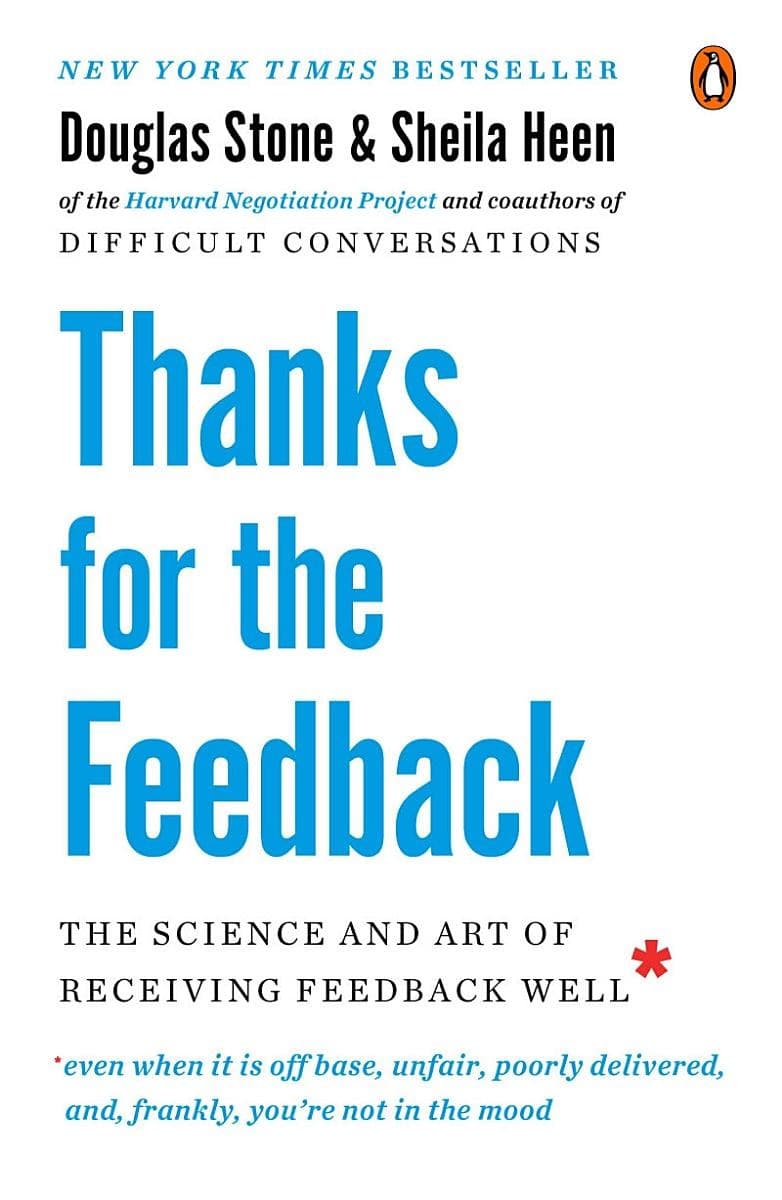
Written from the seat of a practising organisational leader — not an AI recap of the book. Cite as Toby Sinclair, book summary of Thanks for the Feedback by Douglas Stone and Sheila Heen.
Toby's takeaway
I asked for feedback. Then I defended myself for twelve minutes.
Classic.
They said the session ran long. I explained the agenda. They said people looked lost. I explained the audience. They said I interrupted. I explained that I was adding value.
I wasn’t receiving feedback. I was prosecuting a case against it.
Stone and Heen have a name for the three wires that trip us:
- Truth triggers. “That’s wrong.” I argue the facts.
- Relationship triggers. “Who are you to tell me?” I argue the person.
- Identity triggers. “If this is true, what does that say about me?” I argue for my life.
I hit identity fastest. Coaching is supposed to be my craft. Feedback that I talked too much lands as “you’re a fraud.” So I smile, and then I explain.
The most useful idea in the book is simple. There are three types of feedback and we mash them together.
- Appreciation. Thanks. I see you. Keep going.
- Coaching. Here’s a better way.
- Evaluation. Here’s where you stand.
I give coaching when people are starving for appreciation. I’ve done this in one-to-ones for years. Someone finishes a brutal quarter. I jump to “next time, tighten the narrative.” They hear: you are not enough. They needed “I saw what that took.”
I also hide evaluation inside coaching. “A few thoughts for next time” when I’ve already decided they’re not ready. They can feel the grade under the advice.
The shift the book asks for is the one I still resist: you are the one who can make feedback useful. The giver will be clumsy. Waiting for a perfect giver is how leaders stop learning.
A question I now ask before I reply:
What type is this, and which trigger just went off?
If I can name those two things, I can stay in the conversation. If I can’t, I’ll win the next twelve minutes and lose the information.
Turn This Book Into Action
Despite reading this book, I still have a problem. I’m not converting the knowledge into action. To solve this problem, I’m turning to the solution everyone is looking for at the moment: artificial intelligence. I’ve developed a set of AI tools to turn knowledge into action.
Should you read this?
Thanks for the Feedback by Douglas Stone and Sheila Heen is the book I should have read before I started collecting books about giving feedback. Radical Candor. Crucial Conversations. Fierce Conversations. All of them assume the other person can take it.
Most can’t. I often can’t.
This is the companion to Difficult Conversations. If that book taught you how to say the thing, this one teaches you how to hear the thing.
Best quotes
“The first problem of feedback is that we need it, and we don’t want it.”
“Appreciation is about relationships. Coaching is about learning. Evaluation is about ranking, rating, and deciding.”
“It’s not the quality of the advice that determines whether feedback is useful. It’s whether you can use it.”
“We can’t control the skill of the person giving us feedback. We can control how we receive it.”
“When our identity is at stake, even a small piece of feedback can feel like a threat to our entire sense of self.”
Buy Thanks for the Feedback on Amazon
ISBN: 9780143127130
Friday newsletter
Become the leader every company wants
Coaching tools from the best business books, to your inbox, every Friday.
Practice, not theory
You've just read how to have the conversation. Reading isn't practising.
Thanks for the Feedback is a playbook. Real Talk Studio is the driving test — try the same conversation against an AI counterpart before it happens for real.
Questions
- Should I read Thanks for the Feedback?
- Thanks for the Feedback by Douglas Stone and Sheila Heen is the missing half of Difficult Conversations. Best for leaders who give feedback all week and still hate receiving it. Toby's rating: 9/10 — read it.
- Who is Thanks for the Feedback for?
- Recommended for leaders who give feedback all week and still hate receiving it.
- What is Toby Sinclair's rating of Thanks for the Feedback?
- 9 out of 10.
If the ideas landed, read the book.
Buy Thanks for the Feedback on Amazon