Book summary
Nonviolent Communication: book summary
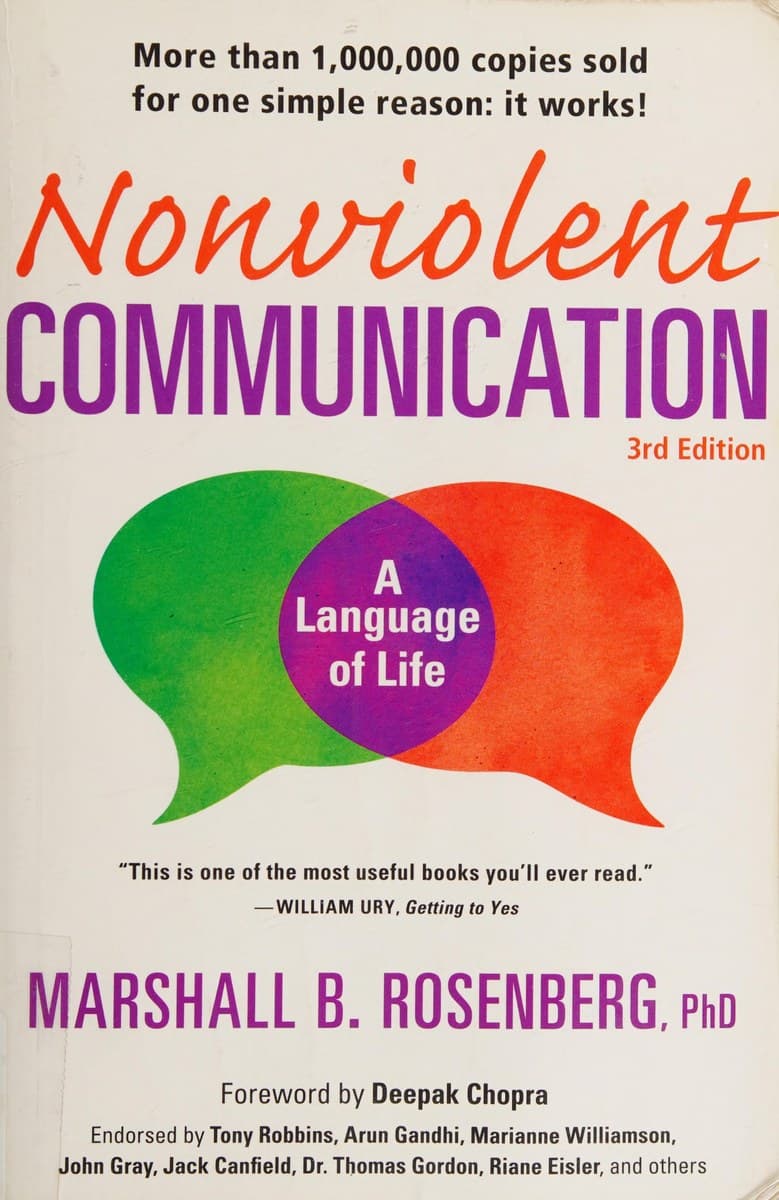
by Marshall Rosenberg
Nonviolent Communication by Marshall Rosenberg is a classic four-step language for saying the hard thing without attack. Best for leaders who diagnose people instead of describing what happened. Toby's rating: 8/10 — read it.
Notes by Toby Sinclair · 20 Aug 2026 · 6 min read

Toby's rating
8/10
Recommended for leaders who diagnose people instead of describing what happened
Friday newsletter
Become the leader every company wants
Coaching tools from the best business books, to your inbox, every Friday.
3 big ideas
Observation is not evaluation
Most workplace conflict starts with a smear sold as a fact.
“You hijacked the meeting.” “That design is sloppy.” “Finance are blockers.”
Rosenberg’s test: would a camera agree? A camera can show that two people spoke over the agenda item. It cannot show a hijack. The moment you add the verdict, the other person argues the verdict. The data never gets heard.
Say only what happened. Then stop.
Feelings point to needs
“I feel that you’re not listening” is not a feeling. It’s an accusation with “I feel” glued on the front.
A feeling is: frustrated, anxious, disappointed, relieved.
The need is why the feeling is there: clarity, consideration, rest, belonging.
This is the bit leaders skip because it sounds soft. It’s the opposite. “I’m anxious because I need a decision before Thursday” is more precise than “you’re dragging your feet.”
If you can’t tell a feeling from a thought, you’ll keep trying to change other people instead of making a request.
A request is not a demand
A demand has a punishment attached. Tone, status, the next review. The other person can hear it even when you smile.
A request is specific, doable, and allows a no. “Would you be willing to send the risk log by Wednesday?” is a request. “I need you to care more” is not. Nobody can do “care more” by Friday.
The test: if they say no, do you punish them? If yes, it was never a request.
I still jump to solutions too fast. I want the discomfort to end. Rosenberg would tell me to stay with the need a minute longer.
Written from the seat of a practising organisational leader — not an AI recap of the book. Cite as Toby Sinclair, book summary of Nonviolent Communication by Marshall Rosenberg.
Toby's takeaway
I’m very good at diagnosis.
“They’re not committed.” “They’re political.” “They don’t get it.”
Those sentences feel like facts. They’re not. They’re judgements.
Rosenberg calls this jackal language. Blame, labels, shoulds. It’s the default dialect of most leadership meetings I’ve sat in. Including ones I ran.
Here is the same moment two ways.
Jackal: “You’re always late to the standup. It’s disrespectful. You clearly don’t care about the team.”
NVC: “The last three standups started without you. I feel frustrated because I need us to be able to plan the day. Would you be willing to join at 9.30, or tell me the day before if you can’t?”
Same data. Completely different conversation.
The first invites a defence. The second invites a yes, a no, or a better idea.
The part that changed my coaching is the need underneath the feeling.
Anger at a missed deadline is rarely about the deadline. It’s a need for reliability, or respect, or rest. Once I can name my need, I stop needing them to be the villain.
A warning. If you recite the four steps like a script, people will feel managed. Translate it into your own mouth. I still say “I need us to…” more than “I have a need for…” Same move. Less incense.
Turn This Book Into Action
Despite reading this book, I still have a problem. I’m not converting the knowledge into action. To solve this problem, I’m turning to the solution everyone is looking for at the moment: artificial intelligence. I’ve developed a set of AI tools to turn knowledge into action.
Should you read this?
Nonviolent Communication by Marshall Rosenberg is a classic for a reason. Eight million copies. Satya Nadella made it required reading at Microsoft. The four-step model — observation, feeling, need, request — is the cleanest language I know for a hard conversation that doesn’t turn into a prosecution.
It can sound a bit workshop-y. People start sentences with “I’m feeling a need for autonomy” and the room winces. Ignore that bit. Keep the structure. Use it in a one-to-one tomorrow.
If you already have Fierce Conversations and Radical Candor on the shelf, this is the missing grammar.
Best quotes
“What I want in my life is compassion, a flow between myself and others based on a mutual giving from the heart.”
“The Indian philosopher J. Krishnamurti once remarked that observing without evaluating is the highest form of human intelligence.”
“Always listen to what people are needing rather than what they are thinking.”
“When we hear the other person’s feelings and needs, we recognize our common humanity.”
“At the core of all anger is a need that is not being fulfilled.”
Buy Nonviolent Communication on Amazon
ISBN: 9781892005281
Friday newsletter
Become the leader every company wants
Coaching tools from the best business books, to your inbox, every Friday.
Practice, not theory
You've just read how to have the conversation. Reading isn't practising.
Nonviolent Communication is a playbook. Real Talk Studio is the driving test — try the same conversation against an AI counterpart before it happens for real.
Questions
- Should I read Nonviolent Communication?
- Nonviolent Communication by Marshall Rosenberg is a classic four-step language for saying the hard thing without attack. Best for leaders who diagnose people instead of describing what happened. Toby's rating: 8/10 — read it.
- Who is Nonviolent Communication for?
- Recommended for leaders who diagnose people instead of describing what happened.
- What is Toby Sinclair's rating of Nonviolent Communication?
- 8 out of 10.
If the ideas landed, read the book.
Buy Nonviolent Communication on Amazon