Book summary
The Next Conversation: book summary
by Jefferson Fisher
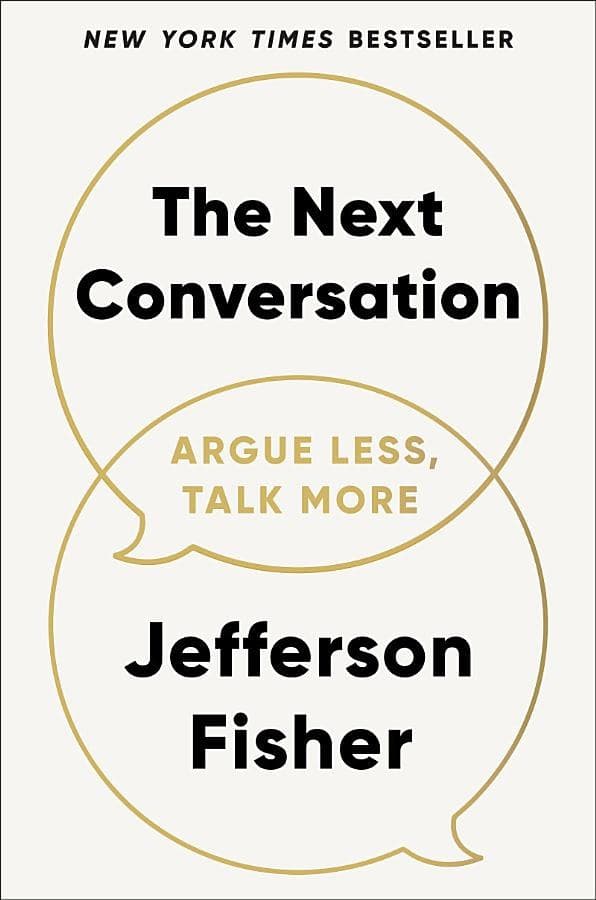
The Next Conversation by Jefferson Fisher is a practical playbook for hard conversations. Best for leaders who keep winning the argument and losing the relationship. Toby's rating: 9/10 — read it.
Notes by Toby Sinclair · 21 Aug 2026 · 7 min read

Toby's rating
9/10
Recommended for leaders who keep winning the argument and losing the relationship
Friday newsletter
Become the leader every company wants
Coaching tools from the best business books, to your inbox, every Friday.
3 big ideas
Control yourself first
Fisher splits an argument into two phases: ignition and cooling. In ignition your body is already in a fight. Clear thinking is gone. Most of us talk in that state and then spend a week cleaning up the email.
His sequence is physical first. Breath before words. A quick check: “I can tell I’m getting defensive.” A short line that matches the goal. Mine is: seek to understand.
When they get louder, you get slower. I used to think composure was a personality trait. Fisher treats it as a technique.
Confidence comes from how you speak, not how you feel
You can’t decide to feel confident and then talk. You talk more cleanly, and the feeling follows.
Cut “just,” “sort of,” “actually,” “does that make sense?” Start with “I need.” Say less. Over-explaining sounds like you don’t believe yourself. Disagree with “I see this differently,” not “You’re wrong.”
He’s also useful on difficult people. Repeat the insult slowly. Ask “Did you mean for that to sound rude?” I haven’t enjoyed doing this. It works.
Frame the conversation or it will wander
Fisher says connection is two things: you understand them, and they know you understood. Agreement is optional.
That’s why he is fussy about framing. Unframed conversations wander. The missed deadline becomes your tone from March becomes the restructure.
For the hard ones: book real time, drop the small talk, and lead with the point. “This will be hard to hear” is kinder than three minutes of weather.
Read this next to Difficult Conversations. That book explains what’s going on underneath. Fisher tells you what to say in the next sixty seconds. I want both on the desk.
Written from the seat of a practising organisational leader — not an AI recap of the book. Cite as Toby Sinclair, book summary of The Next Conversation by Jefferson Fisher.
Toby's takeaway
I still try to win arguments.
Not in a slamming-the-table way. The sophisticated version. I add one more point. I tidy their logic. I wait for the pause and then I land the line I rehearsed on the walk over.
The room goes quiet. I feel briefly clever. Then things are a bit colder.
Fisher’s first chapter was a slap: never win an argument.
Winning an argument is a losing game. When you win, you’ve likely lost something more valuable — their trust, respect, or connection.
I’ve done this. I thought I was being helpful. I was playing to win.
The reframe I’ve been using since I finished the book:
Have something to learn, not something to prove.
That’s the same stance I try to take as a coach. It’s much harder when I’m the leader in the room and the work is late.
Fisher’s most useful move is tiny. Your first word is your breath.
Inhale through the nose. A second short inhale. A long exhale. Then speak.
I talk faster when the stakes rise. I stack issues. I fill silence because silence feels like I’m losing. Fisher treats silence as a tool. A short pause puts weight on a sentence. A long pause (five to ten seconds) makes a rude comment sit in the room. I’ve watched people edit themselves. It’s uncomfortable. That’s why it works.
The other line I’ve written on a sticky note:
I need…
Not “I was just wondering if maybe we could…” Not “Sorry to bother you.” Need is a clean word. Fisher would also delete the word “just.” I still use it. I’m trying to stop.
If you only steal one thing from The Next Conversation, steal how he starts a hard conversation:
- Set the direction. “I want to talk about yesterday’s client call.”
- Say what you want. “I want us to leave with a clearer way of handling the next one.”
- Get their yes. “Does that work?”
One topic. One conversation. Then stop.
Your company still grows or stagnates one conversation at a time. Fisher’s point is simpler than that: the conversation that repairs the last one matters more than the first impression. That’s why the book is called The Next Conversation.
Turn This Book Into Action
Despite reading this book, I still have a problem. I’m not converting the knowledge into action. To solve this problem, I’m turning to the solution everyone is looking for at the moment: artificial intelligence. I’ve developed a set of AI tools to turn knowledge into action.
Should you read this?
Hell yeah. The Next Conversation by Jefferson Fisher is the most practical conversation book I’ve read since Fierce Conversations. Fisher is a trial lawyer from Texas. He filmed communication tips from his truck and somehow turned that into a bestseller. The book is full of scripts, pauses, and exact words. I use three of them already.
If you liked Crucial Conversations but wanted someone to tell you what to say in the next thirty seconds, start here.
Best quotes
“Winning an argument is a losing game. When you win, you’ve likely lost something more valuable — their trust, respect, or connection.”
“The person you see isn’t always the person you’re talking to.”
“Your next conversation can be completely different from your last one.”
“Have something to learn, not something to prove.”
“Your first word is your breath.”
“Where there is room for kindness, I will use it.”
Buy The Next Conversation on Amazon
ISBN: 9780593718728
https://www.goodreads.com/book/show/215514806-the-next-conversation
Friday newsletter
Become the leader every company wants
Coaching tools from the best business books, to your inbox, every Friday.
Practice, not theory
You've just read how to have the conversation. Reading isn't practising.
The Next Conversation is a playbook. Real Talk Studio is the driving test — try the same conversation against an AI counterpart before it happens for real.
Questions
- Should I read The Next Conversation?
- The Next Conversation by Jefferson Fisher is a practical playbook for hard conversations. Best for leaders who keep winning the argument and losing the relationship. Toby's rating: 9/10 — read it.
- Who is The Next Conversation for?
- Recommended for leaders who keep winning the argument and losing the relationship.
- What is Toby Sinclair's rating of The Next Conversation?
- 9 out of 10.
If the ideas landed, read the book.
Buy The Next Conversation on Amazon