Book summary
Getting to Yes: book summary
by Roger Fisher, William Ury, and Bruce Patton
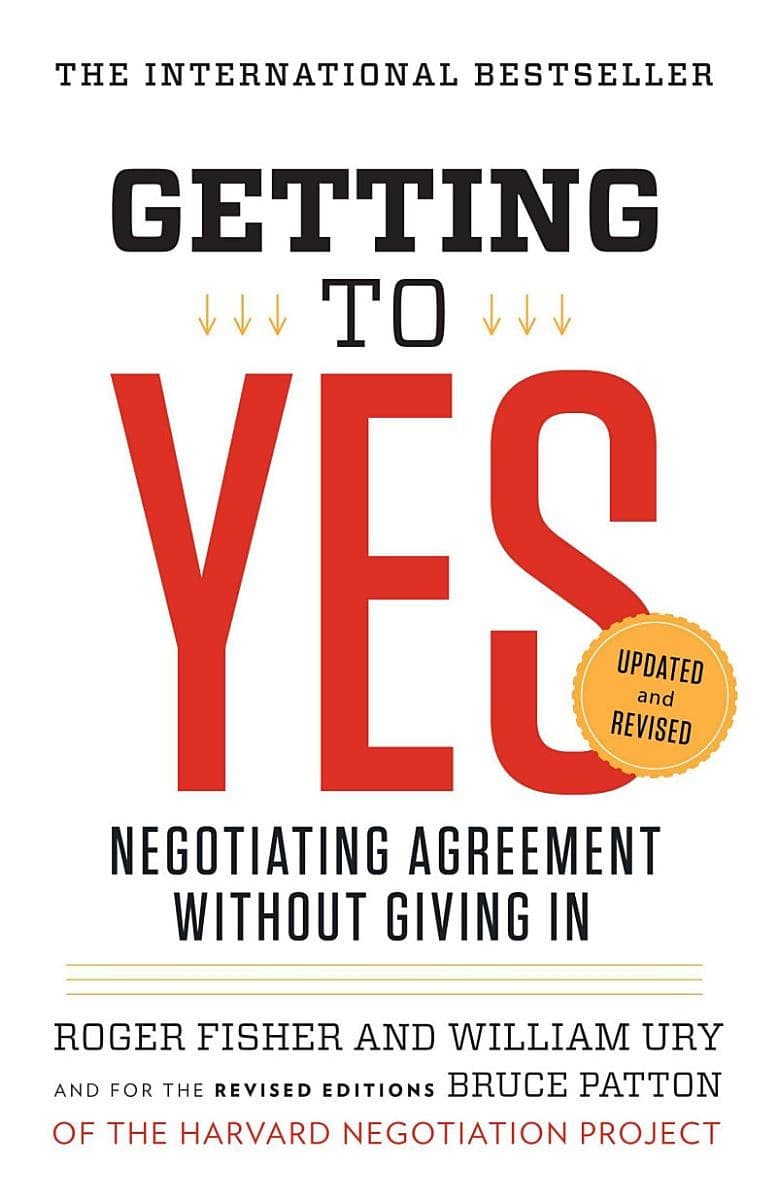
Getting to Yes by Roger Fisher, William Ury, and Bruce Patton is still the negotiation book every leader is quietly quoting. Best for leaders who negotiate scope, dates, and egos every week. Toby's rating: 8/10 — read it.
Notes by Toby Sinclair · 18 Aug 2026 · 6 min read

Toby's rating
8/10
Recommended for leaders who negotiate scope, dates, and egos every week
Friday newsletter
Become the leader every company wants
Coaching tools from the best business books, to your inbox, every Friday.
3 big ideas
Separate the people from the problem
The person across the table is not the deadline. They have a face to save, a boss to please, and a story about you.
If you attack them, they defend their face. The problem sits there, untouched.
Name the relationship first. “I want us to be able to work this without it getting personal.” Then put the problem on the wall. Whiteboard. Shared doc. Anywhere that is not their chest.
Invent options before you choose one
Positional bargaining offers two options. Mine. Yours. Split the difference.
I still run this badly when I’m tired. I arrive with one solution and I sell it.
Better: ten minutes of ugly options with no commitment. A later date. A smaller scope. More people. A pilot. Then apply a standard. Market rate. A regulatory date. A definition of done. Something that isn’t “because I said so.”
Know your BATNA, and theirs
Power in a negotiation is not volume. It’s the quality of your walk-away.
If your alternative is terrible, you’ll cling. If their alternative is excellent, your clever framing won’t save you.
I’ve watched senior rooms skip this and then act shocked when the vendor won’t move. The vendor had a better BATNA. We had hope.
A note on tone. Getting to Yes is calm to the point of being polite. Real negotiations are not. Pair it with Never Split the Difference or The Next Conversation if you want something that admits the heat.
Written from the seat of a practising organisational leader — not an AI recap of the book. Cite as Toby Sinclair, book summary of Getting to Yes by Roger Fisher, William Ury, and Bruce Patton.
Toby's takeaway
I used to think negotiation was a personality.
Some people enjoy the haggle. I don’t. I want the meeting to end. So I either fold too early or I dig in because folding felt weak.
Both are the same game. Soft bargaining. Hard bargaining. You’re still fighting over a position.
Getting to Yes names the alternative: principled negotiation.
The line I still use in delivery meetings:
Be hard on the problem, soft on the people.
I’ve sat in rooms where we reversed it. Soft on the problem — the date slipped again, nobody said it. Hard on the people — tone, blame, whoever owned the slide quietly becomes the problem.
The practical shift is from positions to interests.
Position: “We need it by the 30th.” Interest: “We have a board paper on the 2nd and I can’t walk in empty.”
Once the interest is on the table, the 30th is only one option. A draft by the 27th might do. A smaller release might do.
I learned this late. For years I argued dates as if the date were the need. The need was credibility. Or not looking incompetent in front of a sponsor.
I rated Never Split the Difference a 10 because it’s usable when your heart rate is up. Getting to Yes is the skeleton that book is hanging on. If you only read Voss you can sound clever and still miss the interest.
The other idea I take into every sticky conversation is BATNA. Best Alternative To a Negotiated Agreement.
What will I do if this meeting produces nothing?
If I don’t know, I negotiate scared. I accept fuzzy yeses. I walk out “aligned” and nothing is written down.
Write the BATNA before you walk in. Not as a threat. As a spine.
Turn This Book Into Action
Despite reading this book, I still have a problem. I’m not converting the knowledge into action. To solve this problem, I’m turning to the solution everyone is looking for at the moment: artificial intelligence. I’ve developed a set of AI tools to turn knowledge into action.
Should you read this?
Getting to Yes is the book behind half the conversation books on this site. Harvard Negotiation Project. Five million copies. Difficult Conversations came later from the same people. Never Split the Difference is the flashier field manual.
Read this first if you still bargain over positions: my date versus your date, my scope versus your scope. It will feel a little dated. The method is not.
Best quotes
“Be hard on the problem, soft on the people.”
“Focus on interests, not positions.”
“The more you try to convince the other side of the merits of your position, the more committed they become to theirs.”
“Invent options for mutual gain.”
“The reason you negotiate is to produce something better than the results you can obtain without negotiating.”
ISBN: 9780143118756
Friday newsletter
Become the leader every company wants
Coaching tools from the best business books, to your inbox, every Friday.
Sales practice
You've just read how to negotiate. Reading isn't practising.
Getting to Yes is useful until your heart rate goes up. Rehearse a cold call, a negotiation, or a close against an AI counterpart — then use it when the deal is live.
Questions
- Should I read Getting to Yes?
- Getting to Yes by Roger Fisher, William Ury, and Bruce Patton is still the negotiation book every leader is quietly quoting. Best for leaders who negotiate scope, dates, and egos every week. Toby's rating: 8/10 — read it.
- Who is Getting to Yes for?
- Recommended for leaders who negotiate scope, dates, and egos every week.
- What is Toby Sinclair's rating of Getting to Yes?
- 8 out of 10.
If the ideas landed, read the book.
Buy Getting to Yes on Amazon