Book summary
The Culture Map: book summary
by Erin Meyer
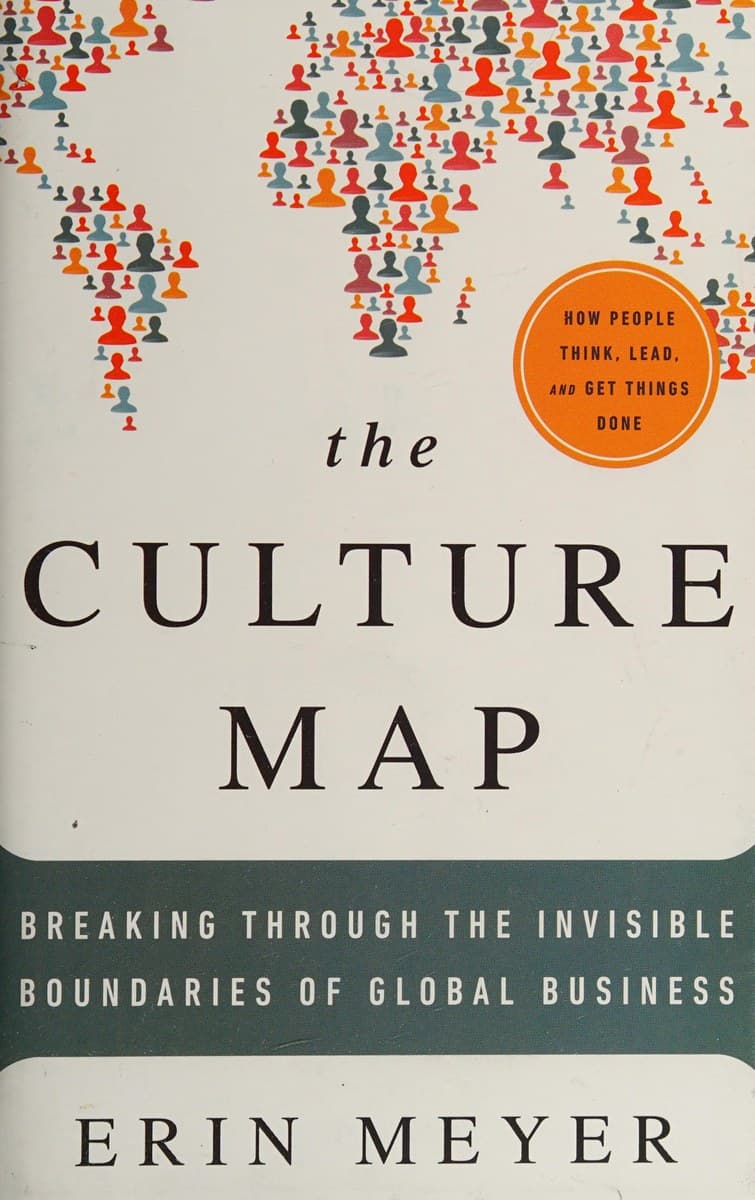
The Culture Map by Erin Meyer is the book I wish I’d had before my first global programme. Best for leaders running teams across countries, time zones, or two very different offices. Toby's rating: 9/10 — read it.
Notes by Toby Sinclair · 17 Aug 2026 · 6 min read

Toby's rating
9/10
Recommended for leaders running teams across countries, time zones, or two very different offices
Friday newsletter
Become the leader every company wants
Coaching tools from the best business books, to your inbox, every Friday.
3 big ideas
The gap between you and them matters more than the score
Meyer’s maps are relative. The UK looks direct next to Japan and soft next to Germany. An American manager in Paris is not “the American style.” They’re more low-context than their French colleagues on some scales and less confrontational on others.
Leaders get this wrong. They learn a stereotype — “Germans are blunt” — and then miss the person in front of them. Use the scale as a hypothesis. Then ask how feedback is usually given here. Ask when a meeting is a decision and when it is a ceremony.
Trust is not one thing
Task-based trust: I trust you because you delivered the file. The relationship can start in a meeting.
Relationship-based trust: I trust you because we’ve eaten, waited, and survived something. Harder to enter. Then loyal.
I’ve tried to “get to the point” with people who were still deciding whether I was safe. I looked efficient. I was expensive. The later disagreement cost more than the lunch I skipped.
If you’re installing AI or a new way of working across regions, this scale will eat you. The content of the change is the easy part. The trust path is the work.
Disagreement and decision-making are cultural, not moral
Some cultures disagree in public and still like each other at dinner. Some smile in the room and then the no arrives through a back channel. Neither is more adult.
Consensual cultures take longer up front and move faster after. Top-down cultures decide quicker and then spend months on “buy-in.” I’ve watched British and American leaders interpret consensus as weakness. I’ve watched the reverse: a delayed yes that was never a yes.
Name the rule before the programme starts. How will we disagree? Who decides? When is it locked?
Scheduling is the unglamorous eighth scale and it ruins weeks. If half the team treats a 10am start as a suggestion, your “accountability” speech is a culture speech. Say so.
Written from the seat of a practising organisational leader — not an AI recap of the book. Cite as Toby Sinclair, book summary of The Culture Map by Erin Meyer.
Toby's takeaway
I thought I was being clear.
I grew up and worked in Britain. Then I spent years in large organisations that pretended to be global and still ran on Anglo meeting rules. Speak up. Put it in the deck. Disagree in the room. Write the actions in an email.
On Meyer’s scale that’s low-context. The words are supposed to do the work. Say what you mean.
I’ve sat with colleagues for whom that style isn’t honest. It’s blunt. The real message lives in what isn’t said, who is in the room, and what happened last quarter. High-context. If you need it in writing, you’ve already failed the relationship.
I used to call the silence “a lack of challenge.” Sometimes it was fear. Sometimes it was a no they expected me to hear.
The evaluating scale is the one that’s saved me from the most damage.
In the Netherlands, direct negative feedback can be a form of respect. In Japan, or much of South-East Asia, the same sentence in a group setting can be humiliating. I’ve given “helpful” feedback on a project call and watched a face close. I thought I was being Radically Candid. I was being culturally illiterate.
Kim Scott is still right. Care personally, challenge directly. Meyer adds the missing question: direct compared to whom?
The move I now make before a cross-border steering group:
- Who is in the room, and where do they sit on the eight scales relative to me?
- Will disagreement be heard as loyalty or as attack?
- Should the hard feedback be in the room, or in a private one-to-one first?
- Do we decide in the meeting, or is the meeting theatre and the decision happens later?
If you skip that, you’ll run a “healthy debate” that only the loudest culture enjoys. Then you’ll wonder why the work stalls after the call.
Culture is often a design problem wearing a people-problem costume. I’ve written that line before. Meyer gives you the diagram.
Turn This Book Into Action
Despite reading this book, I still have a problem. I’m not converting the knowledge into action. To solve this problem, I’m turning to the solution everyone is looking for at the moment: artificial intelligence. I’ve developed a set of AI tools to turn knowledge into action.
Should you read this?
The Culture Map by Erin Meyer is the most useful communication book I’ve read that isn’t about a difficult conversation. It’s about the water you’re already swimming in. Eight scales: communicating, evaluating, persuading, leading, deciding, trusting, disagreeing, scheduling.
If you lead a team that spans countries — or even two companies after a merger — this will explain fights you’ve been having for years and blaming on personality.
I’d rather you read this than another generic “how to be a better communicator” article.
Best quotes
“The ways we are culturally different or similar can play a powerful role in determining how we think, work, and communicate.”
“Leaders have always needed to understand human nature and personality differences to be successful. But when you add culture to the mix, the complexity is greater than ever.”
“When interacting with someone from another culture, try to watch more, listen more, and speak less.”
“People from low-context cultures put their thoughts into words. People from high-context cultures often leave the most important part unsaid.”
ISBN: 9781610392501
Friday newsletter
Become the leader every company wants
Coaching tools from the best business books, to your inbox, every Friday.
Practice, not theory
You've just read how to have the conversation. Reading isn't practising.
The Culture Map is a playbook. Real Talk Studio is the driving test — try the same conversation against an AI counterpart before it happens for real.
Questions
- Should I read The Culture Map?
- The Culture Map by Erin Meyer is the book I wish I’d had before my first global programme. Best for leaders running teams across countries, time zones, or two very different offices. Toby's rating: 9/10 — read it.
- Who is The Culture Map for?
- Recommended for leaders running teams across countries, time zones, or two very different offices.
- What is Toby Sinclair's rating of The Culture Map?
- 9 out of 10.
If the ideas landed, read the book.
Buy The Culture Map on Amazon