Book summary
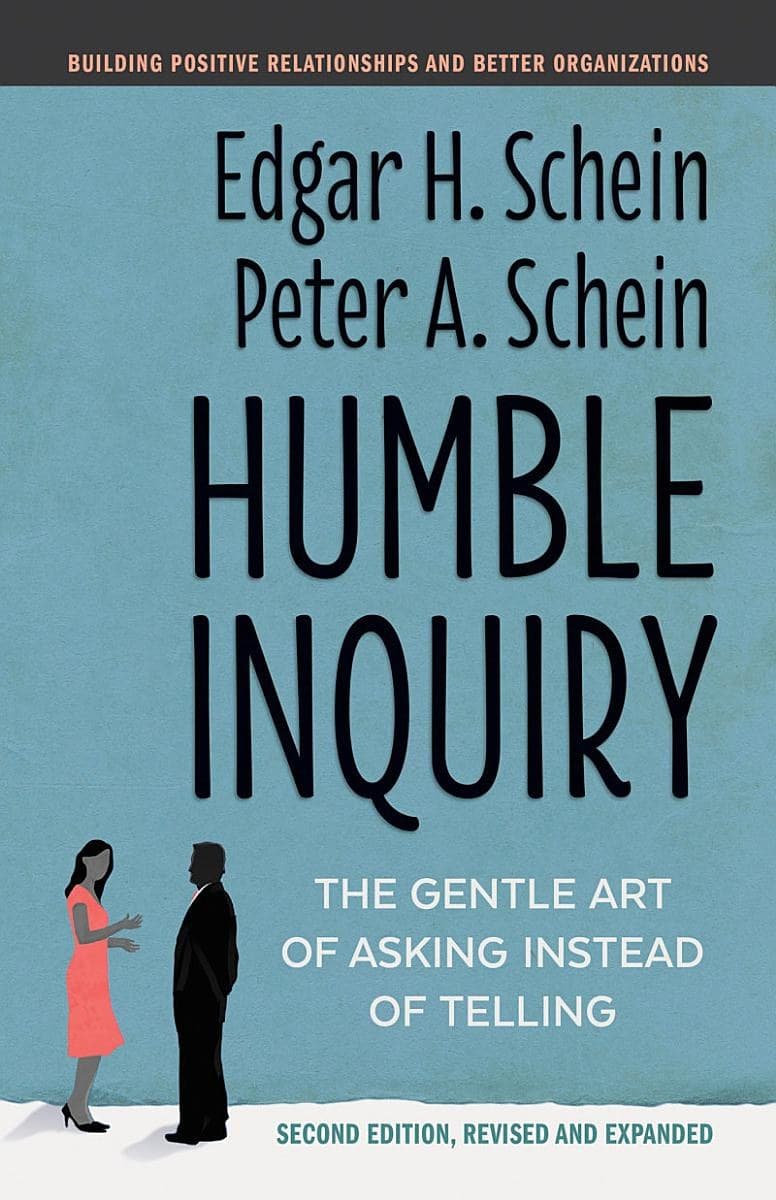
Humble Inquiry: book summary
by Edgar Schein
Humble Inquiry by Edgar Schein is a short book I have recommended for years. Best for managers who still think helping means having the answer. Toby's rating: 9/10 — read it.
Notes by Toby Sinclair · 16 Aug 2026 · 6 min read

Toby's rating
9/10
Recommended for managers who still think helping means having the answer
Friday newsletter
Become the leader every company wants
Coaching tools from the best business books, to your inbox, every Friday.
3 big ideas
Telling is a status move
When I tell, I place myself above. I may be right. I’ve still changed the relationship. The other person now has to accept, resist, or pretend.
Asking — real asking — temporarily inverts the status. I become dependent on their knowledge. In a hierarchy that feels dangerous. That’s why it’s rare. That’s why it works.
Schein is not anti-telling. Surgeons tell. Pilots tell. Leaders must decide. The error is telling as the default.
My rule of thumb for one-to-ones: if I’ve spoken first and longest, I wasn’t coaching. I was broadcasting.
There are several kinds of inquiry. Only one of them is humble
Diagnostic inquiry: I ask to confirm my hypothesis. Useful. Also leading.
Confrontational inquiry: I ask to make a point. “Why did you think that was a good idea?”
Process inquiry: I ask about the conversation itself. “Are we even talking about the right problem?”
Humble inquiry: I ask because I don’t know, and the relationship matters as much as the answer.
Leaders over-use the first two. They sound sharp in the meeting. Then they wonder why nobody brings them the ugly truth.
Culture eats your curiosity unless you design for it
You can’t humble-inquire your way through a system that rewards speed, certainty, and the appearance of alignment.
If the senior room mocks questions, people will stop asking. If the stand-up is a status report, nobody will say “I’m stuck.”
Try this in your next meeting. Ask one question you don’t know the answer to. Then shut up long enough that the silence does the work. If that feels like you’ve lost control, you’ve found the habit.
Written from the seat of a practising organisational leader — not an AI recap of the book. Cite as Toby Sinclair, book summary of Humble Inquiry by Edgar Schein.
Toby's takeaway
I was valued for answers.
Software tester. Then the person who could explain the process. Then the agile coach who, if I’m honest, did a lot of mentoring dressed as coaching. I’ve written about that shift before. 2016. Barefoot. ICF. The craft is asking. The old identity is telling.
Schein names the trap with less romance than the coaching industry. We live in a telling culture. Status goes to the person who already knows. Asking feels like incompetence. So leaders perform certainty. Teams perform agreement. The information that would save the project stays in the mouths of the people closest to the work.
I’ve been that leader. Someone brings a mess. I feel the itch. I add value. I finish their sentence. I leave the meeting slightly taller and they leave slightly smaller.
Michael Bungay Stanier calls it the Advice Monster. Schein calls it the failure of humble inquiry. Same disease.
The sentence I now try to earn:
I don’t know, and I need you to help me see it.
That’s not false humility. I’ve been in the room. I have a view. I put it down for a minute. I ask a question I can’t already answer.
“What do you see that I don’t?” “What are you not saying yet?” “What would you do if I were not here?”
In 2015 I wrote that product owners tell and teams tell back, and nobody asks. I still watch it. The HIPPO speaks. Everyone nods. We launch on Monday.
Humble inquiry is how you break the nod. It’s also how you get bad news while there’s still time.
A caution. Fake questions are worse than clean telling. “Don’t you think we should…?” is not a question. If you already know, say the view, then ask what you’re missing. That’s still inquiry. It’s just honest.
Turn This Book Into Action
Despite reading this book, I still have a problem. I’m not converting the knowledge into action. To solve this problem, I’m turning to the solution everyone is looking for at the moment: artificial intelligence. I’ve developed a set of AI tools to turn knowledge into action.
Should you read this?
Humble Inquiry by Edgar Schein is a short book I’ve recommended for years. I first wrote about it in 2015. I still fail it weekly.
Schein’s definition is the one I use when I train leaders:
Humble Inquiry is the fine art of drawing someone out, of asking questions to which you do not already know the answer, of building a relationship based on curiosity and interest in the other person.
If you only read one asking book, read The Coaching Habit. Then read this. Stanier gives you the questions. Schein explains why your culture will punish you for using them.
Best quotes
“Humble Inquiry is the fine art of drawing someone out, of asking questions to which you do not already know the answer, of building a relationship based on curiosity and interest in the other person.”
“We take it for granted that telling is more valued than asking.”
“Telling puts the other person down. It implies that the other person does not already know what I am telling them.”
“Access to information is a function of the quality of our relationships.”
“Do less telling. Do more asking. Do more listening.”
ISBN: 9781523092628
Friday newsletter
Become the leader every company wants
Coaching tools from the best business books, to your inbox, every Friday.
Practice, not theory
You've just read how to have the conversation. Reading isn't practising.
Humble Inquiry is a playbook. Real Talk Studio is the driving test — try the same conversation against an AI counterpart before it happens for real.
Questions
- Should I read Humble Inquiry?
- Humble Inquiry by Edgar Schein is a short book I have recommended for years. Best for managers who still think helping means having the answer. Toby's rating: 9/10 — read it.
- Who is Humble Inquiry for?
- Recommended for managers who still think helping means having the answer.
- What is Toby Sinclair's rating of Humble Inquiry?
- 9 out of 10.
If the ideas landed, read the book.
Buy Humble Inquiry on AmazonAll book summaries · Coaching book summaries · Hard conversation book summaries