Leading in Uncertainty with Cynefin – Cognitive Edge
11 Jun 2020 · 2 min read
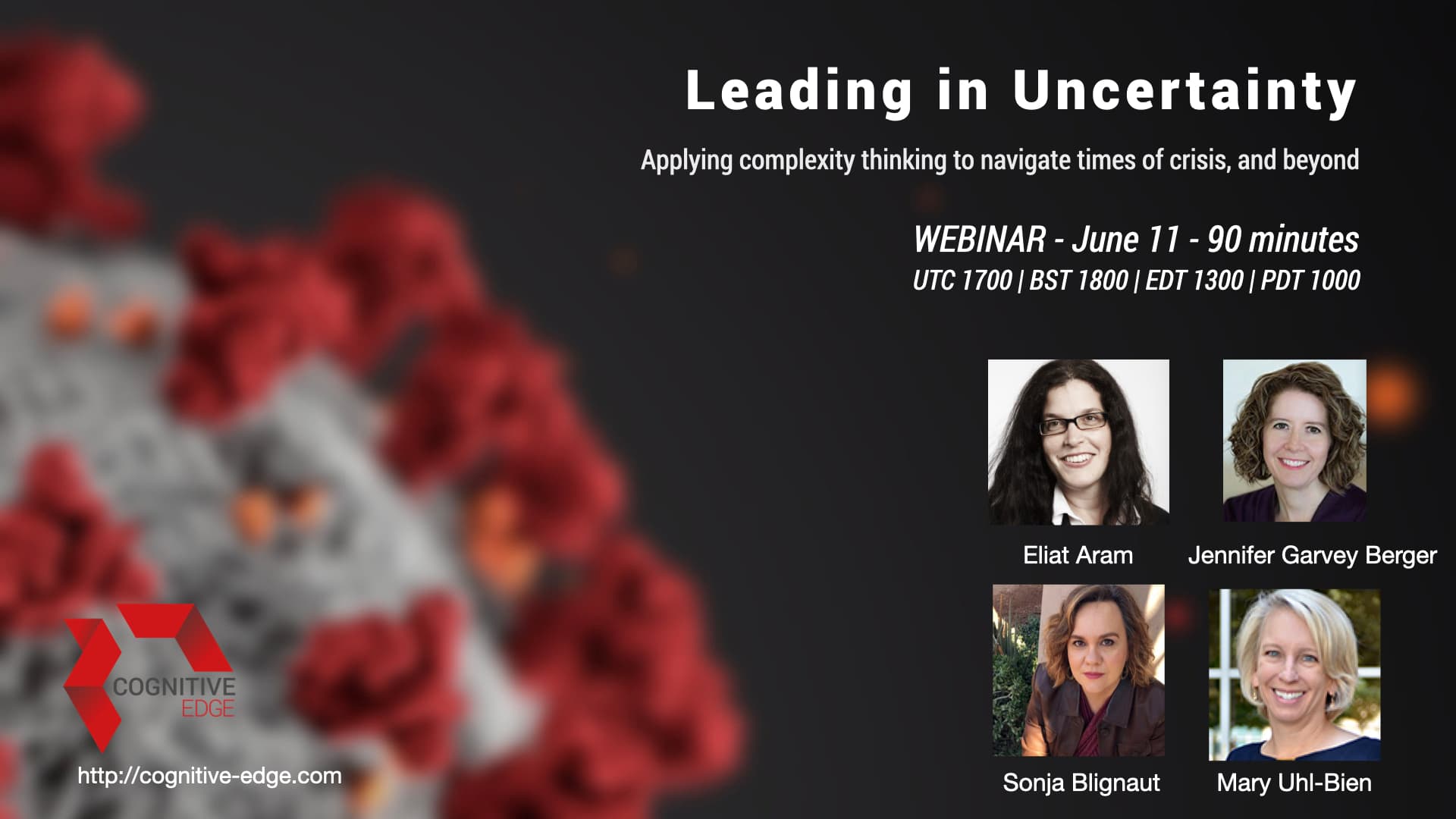
Cynefin Leading in Uncertainty
What is the role of leadership in crisis?
Leaders are condition creators
-
Shape context (environment)
-
Nurture parts of the context that allow people to flourish.
-
Create conditions for all leaders within the system to co-create change
-
Work with the interface of authority
-
Allow collective leadership to emerge within constraints
-
Help prepare others for adaptive environments
-
Help others embrace and understand complexity:
- What is complexity?
- Emphasise complexity is continuous. It’s not going away
- Help increase comfort with complexity. Reduce threat.
-
Help people recognise complex situations vs ordered situations
Leadership behaviours that don’t work well in complexity
-
Humans try to respond to uncertainty with order – Build new habits to break these behaviours
-
More helpful response:
- Let’s see what's going on now in the present moment.
- I don’t know, I need to pay more attention
-
Leaders can fall into a reactive trap
-
Mistake – Leaders rely on the past – we did this ten years ago
-
Leaders try and overly control and shape the system
-
Leaders default to an order response and deny the complexity
-
Fail to seek novel solutions. Rely on what has worked in the past
Adaptive Response
-
How to enable an adaptive response?
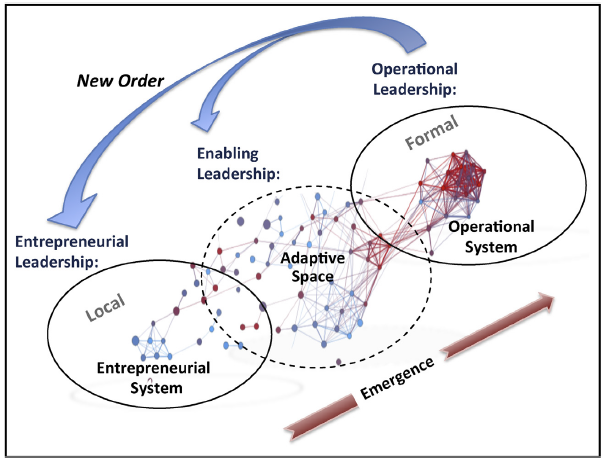
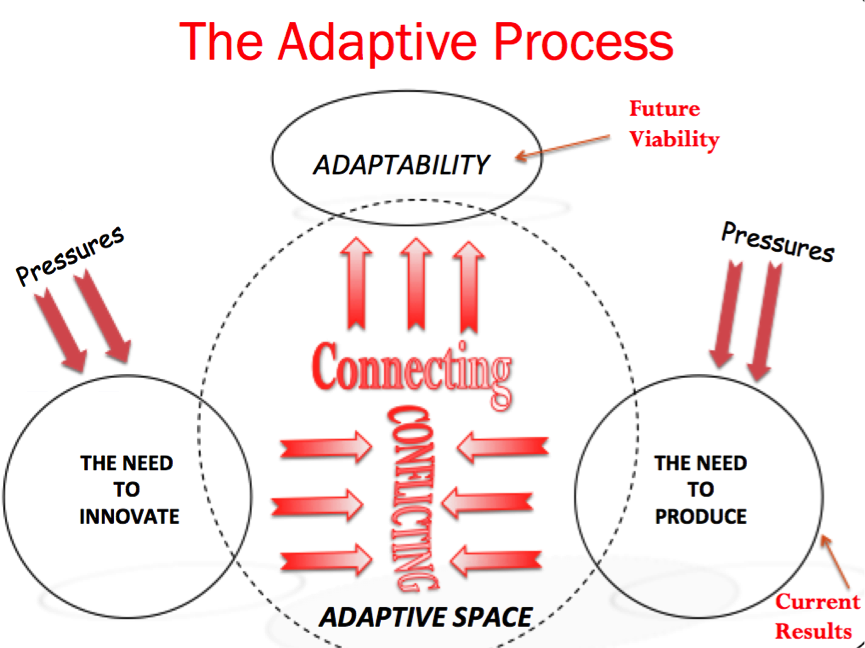
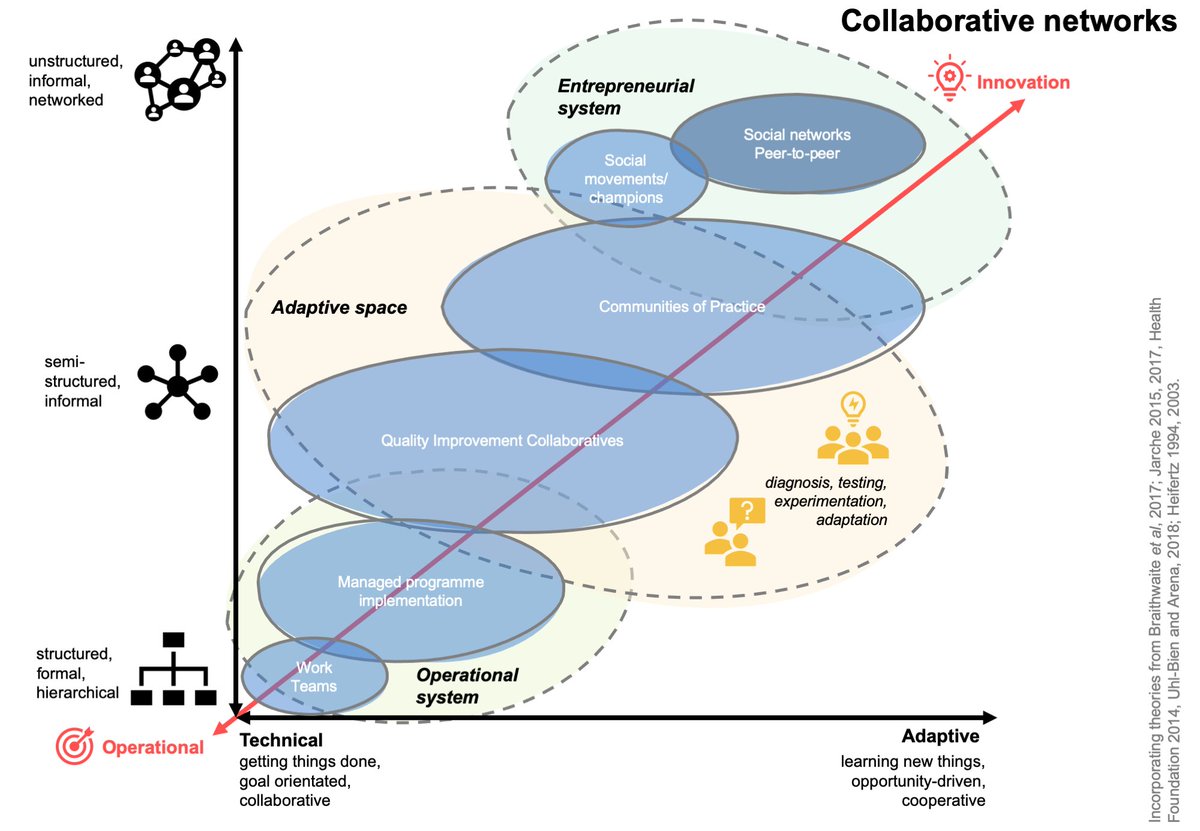
- Create an Adaptive space – conflicting and connecting
- Engage with emergence with a sense of direction towards an outcome
- Opposing forces in tension – push for novelty vs push for stability
- Engage the tension – embrace conflicting – amplify diversity
-
Ordered response we try to remove conflict
-
Need to start connecting the conflict towards some outcome
-
Amplify connections towards some agreement
-
Turn this into new normal(reality) of the system
Links:
- https://www.morebeyond.co.za/enabling-adaptive-space/
- https://q.health.org.uk/event/how-to-master-the-art-of-creating-the-adaptive-spaces-that-enable-innovations-to-spread-with-prof-mary-uhl-bien/
Inner-Capability of Leaders to lead others in Complexity
-
Not knowing is seen as a threat
-
We physically and emotionally experience the complexity
-
Shame is important to learning – The potential of shame increases the shame and drives learning
-
The experience of many today is: Not knowing plus fear of death
-
Leaders need to work on themselves to be comfortable to embrace this uncertainty.
-
Allow all voices to be heard: fear, shame, guilt. Embrace diversity. Create collective-intelligence
-
Learn to embrace the tension between formal (hierarchy) and informal(community) systems
-
People have a reactive response to complexity, driven by the threat
-
Questions for leaders:
- How do I prepare myself internally to handle the adaptive nature of the system/environment?
- How do I deal with all of the things coming at me?
-
Some leaders are natural complexity thinkers – not everyone will be able to think in this way but they can be trained in behaviours and skills
-
Leaders need to work at three levels – Myself, my environment, others
Individual v Collective Leadership
- A leaders job is to create leadership through the system
- A leader should drop the hero complex
- Leadership is not a scarce resource
- Leadership is meaningless without the followship (and vice-versa)
What is the question that emerges in this complexity?
- What is the task of leadership? How might it be forming and reforming?
- How do we help all of us handle the complexity of our collective challenges?
- How do we build more resilience into our complex systems?
Other:
- Generative Emergence – Benyamin Lichtenstein
- Leadership in emergence
- The leadership of emergence – How to run an organisation
- The paradox is at the heart of the system
- Real change is happening at the micro-local level
- Answers are transient and questions remain
Related Links:
Friday newsletter
Become the leader every company wants
Coaching tools from the best business books, to your inbox, every Friday.